
Cubital Tunnel Syndrome
Tingling and numbness in the little and ring fingers, with a grip that's losing its strength — the signs of a trapped ulnar nerve at the elbow, and how nerve testing pins it down.

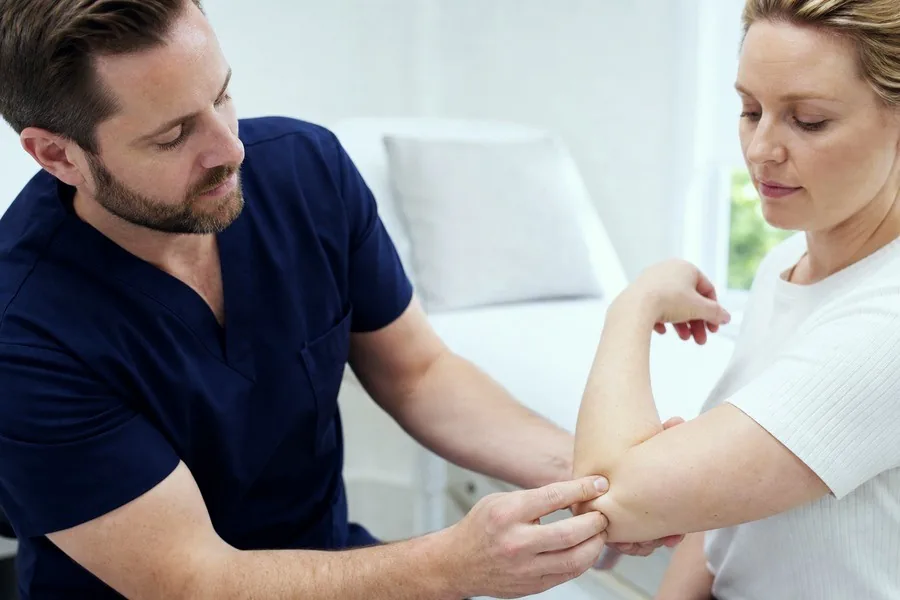
Cubital tunnel syndrome happens when the ulnar nerve — the one behind the dead-arm jolt when you knock your 'funny bone' — is squeezed or stretched.
The trouble arises as the nerve passes through a narrow channel on the inner side of the elbow. It is the second most frequent trapped nerve in the arm, after carpal tunnel syndrome. Because the ulnar nerve controls feeling in the little and ring fingers and powers many of the small muscles that grip and pinch, pressure on it shows up as tingling in those fingers and a hand that tires or fumbles. Confirming exactly where and how badly the nerve is affected is what makes a sensible plan possible — and that is precisely what nerve testing does.
Symptoms of cubital tunnel syndrome.
Symptoms often start intermittently and are frequently worse when the elbow stays bent for a while — on the phone, asleep, or driving.
Why it happens.
The ulnar nerve is vulnerable at the elbow because it sits close to the surface and gets stretched every time the joint bends. Several things can add to the pressure or irritation.
Don't wait for it to settle.
Early assessment helps you get the right treatment sooner. See a specialist if:
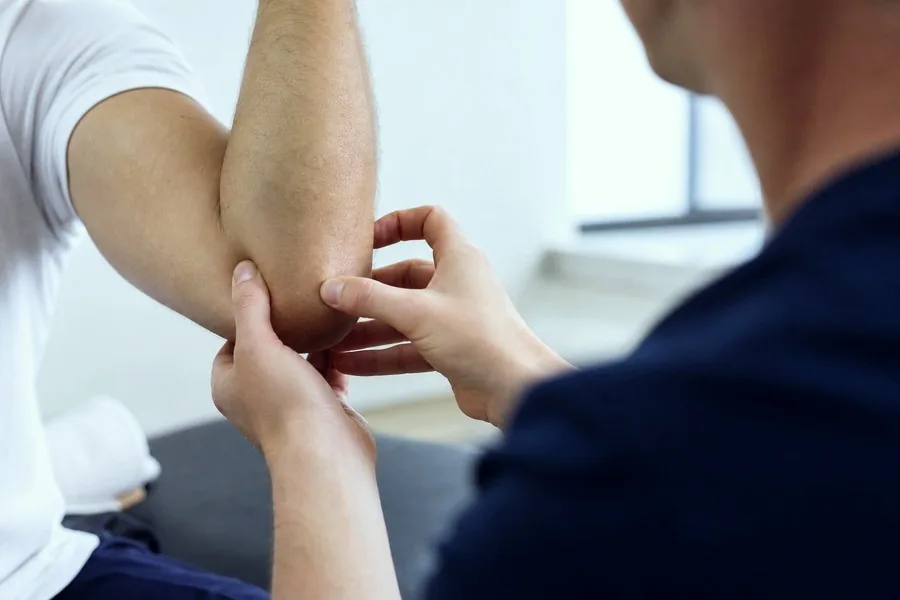

Confirmed by nerve conduction studies and EMG.
The defining test for cubital tunnel syndrome is a nerve conduction study with EMG. Dr Arvin Rodrigues, Consultant Clinical Neurophysiologist, performs and interprets the testing himself: small electrical pulses measure how well and how fast the ulnar nerve carries signals across the elbow, while a fine-needle EMG checks the muscles it supplies. Together these localise where along the elbow the nerve is affected, how severe it is, and rule out other causes such as a problem in the neck — the objective answer that guides the right next step. Where imaging such as an MRI or X-ray would add to the picture, it is arranged separately, as scans are not performed on-site.
How cubital tunnel syndrome is treated.
Our role here is accurate diagnosis. The findings from your nerve testing show how the nerve is faring and steer the right management for you.
A one-to-one appointment with Dr Arvin Rodrigues to review your symptoms, examine the arm and hand, and decide which nerve testing is needed to confirm what's going on.
The definitive test for cubital tunnel syndrome — measuring the ulnar nerve across the elbow and checking the hand muscles to locate the compression and grade how severe it is.
Once testing is complete you receive a clear report. Depending on what it shows, this may mean simple measures such as a night-time elbow splint and posture changes, or onward referral to a hand or nerve surgeon — we set out the options honestly and write to whoever you'd like.
Seen in days — not months on a list.
A named specialist, not a junior — all the way through.
Every price published and confirmed in writing.
Seen privately, without the wait.
We bill major UK insurers directly.

How is cubital tunnel syndrome diagnosed? +
By a nerve conduction study with EMG. The study sends small electrical pulses along the ulnar nerve to measure how well it conducts across the elbow, and the EMG uses a fine needle to check the hand muscles the nerve supplies. Together they confirm cubital tunnel syndrome, show how severe it is, and rule out other causes such as a trapped nerve in the neck. Dr Arvin Rodrigues carries out and interprets the testing himself.
Does the nerve test hurt? +
Most people find it very manageable. The nerve conduction part uses brief, mild electrical pulses that feel like a quick tap or buzz, and the EMG part involves a fine needle in a few muscles, which is more of a pressure than a sharp pain. The whole appointment is over within around an hour.
What does nerve testing for cubital tunnel syndrome cost? +
A neurophysiology consultation is from £450, and a nerve conduction study with EMG of the upper limbs is £450. If lower limbs need testing too, that's £500 for the legs alone or £550 for upper and lower combined. Every price is published upfront, so you'll know the cost before going ahead.
What happens after the test — does the clinic treat it? +
Our role is diagnosis. You receive a clear report on exactly what the testing found, and that guides the right next step. Depending on the result this might be straightforward measures such as a night-time elbow splint and avoiding leaning on the elbow, or onward referral to a hand or nerve surgeon if that's what your case calls for — we'll happily write to your GP or the specialist of your choice.
Don't put up with it.
Book an assessment with a consultant and get a clear picture — and a plan.