
Venous Insufficiency
Aching, heavy legs and skin changes around the ankle that worsen as the day goes on — what venous insufficiency is, why the valves in your leg veins stop working, and how a vascular consultant can help.

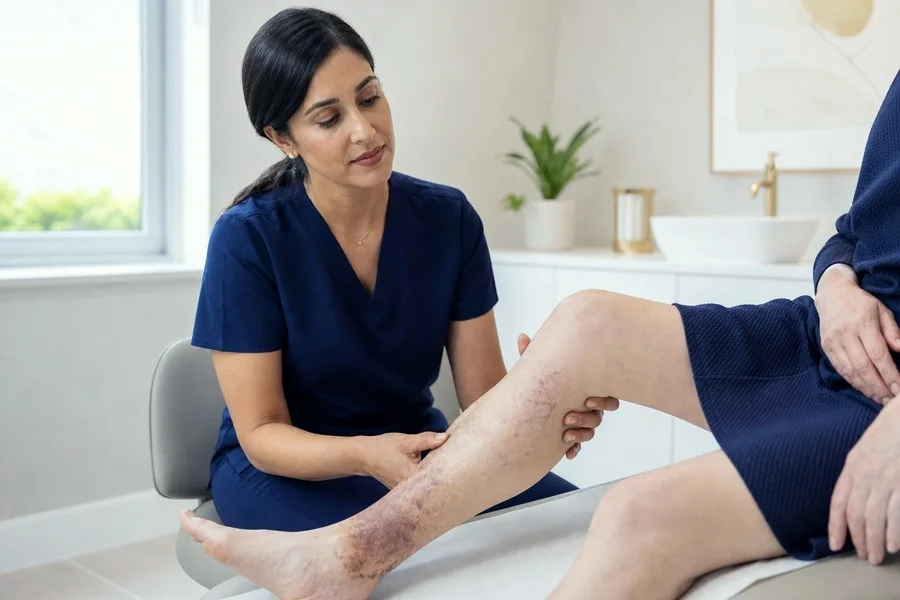
Venous insufficiency is when the one-way valves inside your leg veins no longer close properly, so blood pools in the lower leg instead of flowing back up to the heart.
It's a common and progressive problem, but very treatable once the faulty veins are mapped. Left alone the pressure builds over years and can damage the skin around the ankle — which is why it's worth understanding what's happening and getting the underlying veins assessed.
Symptoms of venous insufficiency.
Symptoms typically build through the day and ease when you put your legs up — and they tend to creep on gradually rather than appear overnight.
Why it happens.
The root problem is leaky vein valves that let blood flow backwards and pool, raising the pressure in the lower leg. Several things make those valves more likely to fail.
Don't wait for it to settle.
Early assessment helps you get the right treatment sooner. See a specialist if:
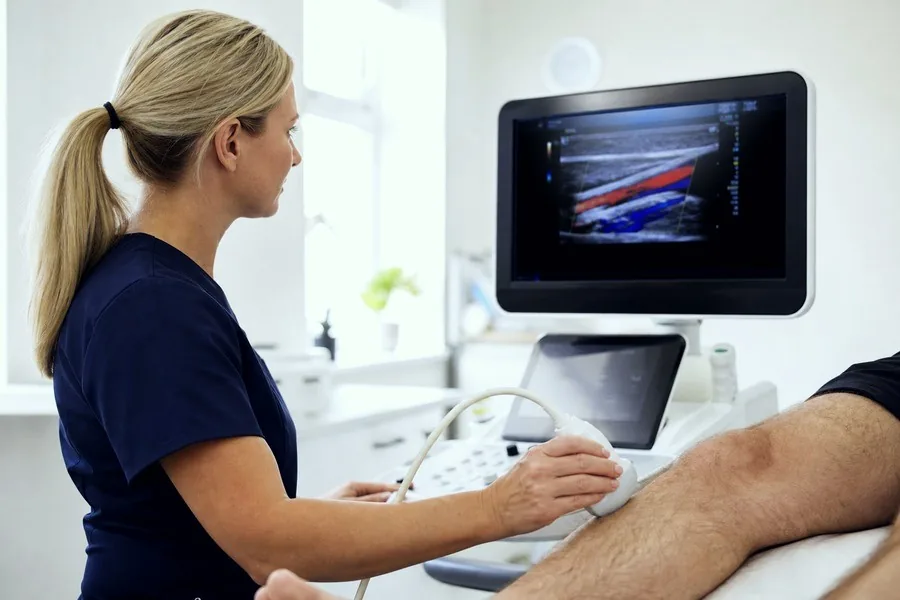

Confirmed with a duplex ultrasound scan of the leg veins.
Venous insufficiency is diagnosed by examining the leg and using a duplex ultrasound scan, which shows in real time which valves are leaking and which veins are involved. Mr Tamer Ghatwary, Consultant Vascular & Endovascular Surgeon, uses that map to confirm the diagnosis and explain which veins are causing your symptoms and what can be done about them.
How venous insufficiency is treated.
Treatment is matched to your scan and how advanced things are — starting with conservative measures and moving to a targeted procedure when the veins themselves need treating.
An expert assessment of your leg veins with an ultrasound scan to map exactly which valves are failing — the starting point for any plan.
Graduated compression stockings, leg elevation, walking and weight management to ease symptoms and slow progression, often advised alongside or before a procedure.
A foam medicine injected to close off faulty veins, done under local anaesthetic as a walk-in, walk-out treatment with a day or two to recover.
A minimally invasive technique that seals the troublesome vein from the inside under local anaesthetic — one leg at a time, with no general anaesthetic.
Seen in days — not months on a list.
A named specialist, not a junior — all the way through.
Every price published and confirmed in writing.
Seen privately, without the wait.
We bill major UK insurers directly.

Is venous insufficiency the same as varicose veins? +
They're closely linked. Varicose veins are often the visible sign of venous insufficiency — the underlying valve problem — but you can have aching, swelling and skin changes from leaking valves even without obvious bulging veins. The duplex scan shows what's really going on.
Do I need to be referred by my GP first? +
No — you can book a vascular consultation directly. If you'd like your GP kept in the loop we're happy to write to them, but a referral letter isn't needed to be seen.
What happens at the assessment and what does it cost? +
Your first appointment is a £200 consultation with Mr Tamer Ghatwary, including an examination and a duplex ultrasound scan of your leg veins. He'll explain which veins are affected and recommend a plan; the cost of any procedure is confirmed before you decide. A follow-up consultation is £145.
Will the treatment need a general anaesthetic or a hospital stay? +
No. Both foam sclerotherapy and ClariVein are done under local anaesthetic on a walk-in, walk-out basis, with most people back to gentle normal activity within a day or two. There's no overnight stay.
Can both legs be treated at the same time? +
It depends on the treatment. Foam sclerotherapy can be carried out on both legs together, whereas ClariVein is done one leg at a time. Your consultant will advise the right order for you based on your scan.
What if I leave it untreated? +
Venous insufficiency tends to progress slowly. Symptoms may worsen and, over time, the persistent pressure can cause skin discolouration, venous eczema and in some cases an ankle ulcer. Getting the veins mapped early gives you the option to act before that stage.
Don't put up with it.
Book an assessment with a consultant and get a clear picture — and a plan.