
Radiofrequency Nerve Ablation in Rossett
A targeted, image-guided day-case treatment for the small nerves that carry your pain — aiming for longer relief than an injection alone, led by a consultant in pain medicine with no NHS waiting list.
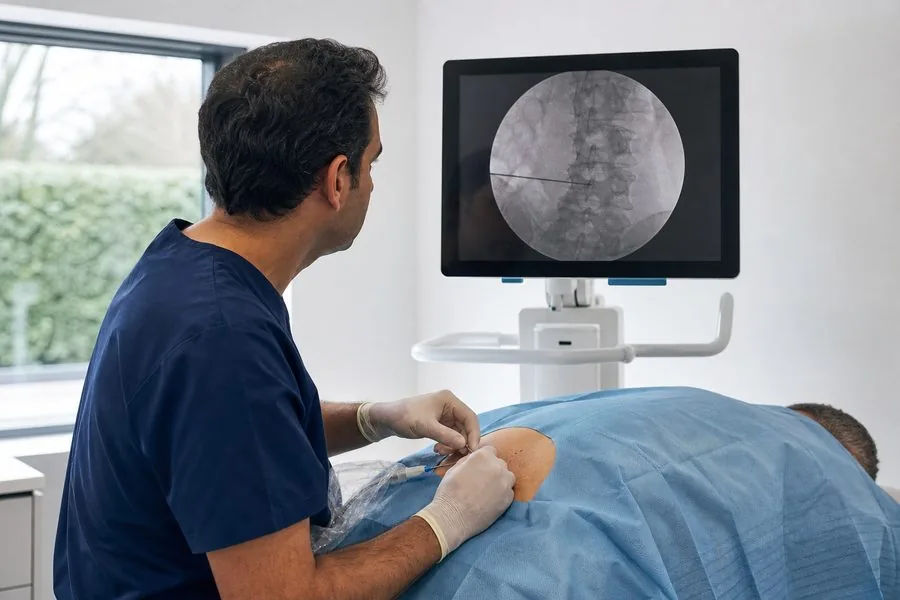
Radiofrequency nerve ablation uses precisely controlled heat to interrupt the tiny nerves that relay a pain signal — for example the small nerves serving the facet joints in the spine. Because it acts on the nerve itself the relief it offers tends to outlast a steroid injection.
The procedure is carried out under image guidance as a day-case using local anaesthetic, and a diagnostic nerve block is often performed first to confirm that those particular nerves are the source of your pain. At Bridge House Clinic in Rossett it is led by Dr Mohamed Khafaga, Consultant in Anaesthesia & Pain Management, with prices published upfront and no need to wait on an NHS list.
Radiofrequency ablation works on specific, confirmed nerves, so any prior imaging, clinic letters or the result of an earlier diagnostic block helps Dr Khafaga plan exactly which nerves to treat.
Tell the clinic about blood-thinning medication and any other regular prescriptions when you book, as some may need adjusting beforehand. Eat and drink normally unless we advise otherwise.
Although it is a day-case under local anaesthetic, it is sensible to have someone drive you afterwards and to keep the rest of the day quiet so the treated area can settle.
Why have your ablation here

Dr Khafaga reviews your history and any earlier diagnostic block, then explains which nerves will be treated and what the procedure involves before you give consent.
You are positioned comfortably and the skin is cleaned. Live imaging is used to guide a fine probe to the precise nerves, with local anaesthetic numbing the area first.
Controlled heat is delivered through the probe to interrupt the small nerves carrying your pain. You stay awake throughout and are monitored the whole time.
The probe is removed and you rest briefly before going home the same day. Dr Khafaga explains what to expect as the area settles and how relief may build over the following weeks.
When facet-joint pain affects your back
Worn or irritated facet joints are a common source of ongoing back pain, and the small nerves serving them are a frequent target for radiofrequency ablation. If you are still working out what is driving your pain, it is worth reading more first.
Learn about back pain →
Know the cost before you book.
Every price is fixed and published upfront. A £50 deposit secures your appointment and comes off the total.
Book now→How much does radiofrequency nerve ablation cost at Bridge House Clinic? +
The procedure is £1,100. Any diagnostic nerve block carried out beforehand is discussed separately at your assessment.
Do I need a GP referral to book? +
No. You can arrange an assessment with us directly. Dr Khafaga will still confirm that ablation is the right option, and whether a diagnostic block is needed first, before anything goes ahead.
What is the procedure like, and how long until I'm back to normal? +
It is a day-case under local anaesthetic, so you stay awake and go home the same day. The treated area can feel sore for a short while afterwards; Dr Khafaga will explain what to expect for your particular treatment.
How is it different from a steroid injection? +
An injection mainly delivers medication around the area, whereas ablation uses controlled heat to interrupt the small nerves carrying the pain itself, which is why it often gives longer-lasting relief.
Why is a diagnostic nerve block sometimes done first? +
A diagnostic block helps confirm that the nerves being considered really are the source of your pain. If it points to those nerves, ablating them is more likely to help.
Book radiofrequency nerve ablation.
From £1,100, published upfront — with no GP referral needed.