
Trigger Finger Treatment in Rossett
Treatment for a finger that catches, clicks or locks as you bend it — led by a consultant hand and wrist surgeon. Most cases settle with a single injection, with no NHS waiting list.
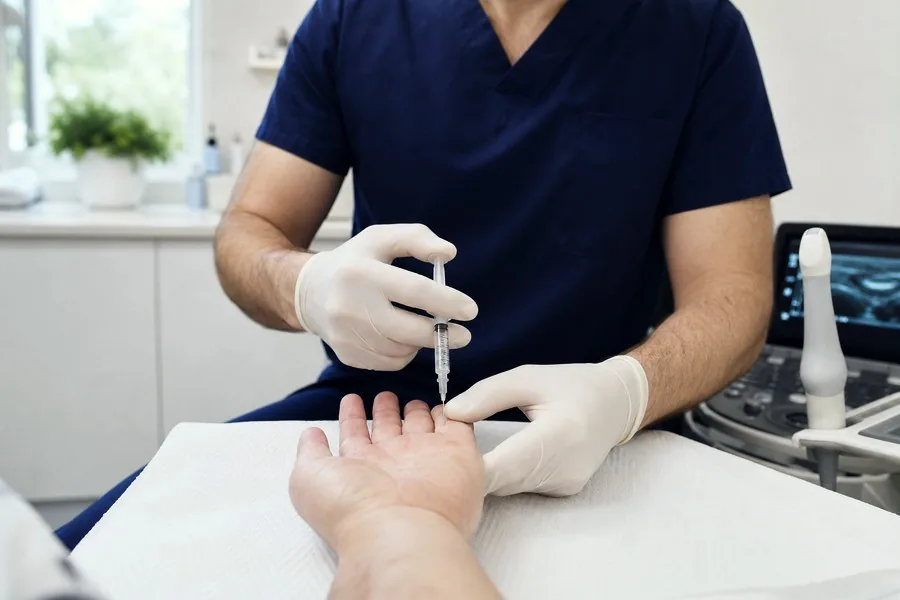
Trigger finger develops when the tendon that bends a finger or thumb no longer glides smoothly through its sheath, so the digit catches, clicks or locks in a bent position and can be stiff and sore — especially first thing in the morning. Treatment here is stepwise.
For most people a steroid injection around the affected tendon eases the catching and is all that is needed, and it can be done in an outpatient appointment. Where the triggering keeps coming back or doesn't settle, the next step is a small open release of the tight part of the sheath, carried out as a day-case under local anaesthetic. Care is led by a consultant hand and wrist surgeon, and you can book directly with no GP referral and no NHS waiting list.
Your clinician will confirm the most suitable method at your appointment.
Jot down which finger or thumb catches, whether it locks fully and when it's worst — this helps the consultant hand and wrist surgeon judge how advanced it is and which step suits you.
Tell us if you take blood-thinners or have diabetes, as both can affect the timing and response to a steroid injection.
If a release is on the cards, arrange for someone to drive you home and keep the hand rested and clean for the first day or two afterwards.
Why have your trigger finger treated here

The consultant hand and wrist surgeon examines the hand, watches the finger move through its range and confirms it's trigger finger rather than another cause of catching or stiffness.
Because treatment is stepwise, we talk through whether to start with an injection or, for stubborn cases, move to a release — and what each involves.
Most people have the steroid injection there and then. If a release is needed, it's booked as a short day-case under local anaesthetic, so you're awake and go home the same day.
You'll leave with clear advice on gentle movement and, after surgery, on the small wound and stitch care, along with any follow-up that's needed.
What's behind the catching
Trigger finger happens when a tendon thickens and snags as it passes through its sheath, making the digit click or lock. Understanding why it develops can help you choose between an injection and a release.
Learn about trigger finger →Know the cost before you book.
Every price is fixed and published upfront. A £50 deposit secures your appointment and comes off the total.
Book now→Do I need a GP referral? +
No — you can book an assessment for trigger finger directly with us, with or without a letter from your doctor.
How much does treatment cost? +
A steroid injection with ultrasound guidance is £350 for one finger or £600 for two fingers. If a surgical release is needed, that's £1,900 for an open release or £2,500 for a keyhole release, as a day-case.
Will I definitely need surgery? +
Usually not. For most people a steroid injection settles the triggering, and surgery is only considered as the next step if the problem persists or keeps returning.
What is the release operation like? +
It's a small open procedure done as a day-case under local anaesthetic, so you're awake, the hand is numbed and you go home the same day. The consultant hand and wrist surgeon releases the tight part of the tendon sheath through a small incision in the palm.
What happens after treatment? +
After an injection you can use the hand normally and the catching often eases over the following days. After a release you'll have advice on caring for the small wound and on gentle movement, with any follow-up arranged at the time.
Book trigger finger treatment.
From £350, published upfront — with no GP referral needed.