
Knee Pain
Knee pain is one of the most common reasons people seek help, and it has many possible causes. At Bridge House Clinic in Rossett, between Chester and Wrexham, our physiotherapy team can assess your knee and build a tailored rehabilitation plan, with a targeted joint injection available for persistent or inflammatory pain. Private appointments, no NHS waiting list, and self-referral is welcome.
Also under:Pain Management
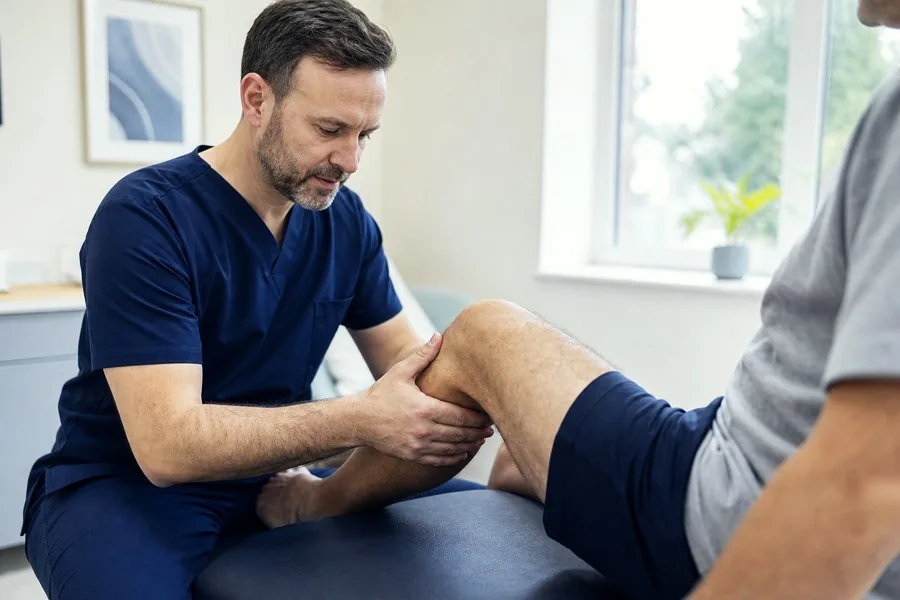
Knee pain is discomfort in or around the knee joint that can come on suddenly after an injury or build up gradually over time.
The knee is a complex joint where bone, cartilage, ligaments and tendons all work together, so pain can come from many different structures. It may affect the front, sides, back or deep inside the joint, and can range from a mild ache to pain that limits walking, stairs or sport. Because the causes vary so widely, this page is a general guide rather than a diagnosis. The right starting point for most knee pain is a proper assessment to build a clear picture of what is going on, which is exactly what our physiotherapy team provides.
Symptoms of knee pain.
Knee pain shows up in different ways depending on the cause. You may notice one or several of the following.
Why it happens.
Knee pain can come from the joint itself, the surrounding soft tissues, or wider patterns of loading and overuse. Common causes include the following.
Don't wait for it to settle.
Early assessment helps you get the right treatment sooner. See a specialist if:


How we assess your knee
Our physiotherapy team takes a full history and examines how your knee moves, where it hurts and how the surrounding muscles are working. This hands-on, one-to-one assessment helps build a clear picture of what is driving your pain and guides a tailored plan. If we think a structural problem may need imaging or a specialist opinion, we will explain that and arrange the right onward step.
How knee pain is treated.
Treatment depends on what is causing your knee pain. For most people, physiotherapy is the first-line route, with a joint injection available where pain is persistent or inflammatory, and onward referral when a structural problem may need surgery.
One-to-one, team-led assessment and a tailored rehabilitation programme to reduce pain, restore movement and strengthen the knee. This is the recommended starting point for most knee pain.
A targeted injection given by Dr Mohamed Khafaga, Consultant in Anaesthesia and Pain Management, for persistent or inflammatory knee pain. It relieves pain rather than curing the underlying problem and may need repeating.
Where a structural problem may require surgery, we arrange referral to the right specialist. The clinic does not perform knee surgery.
Private appointments mean you can be seen quickly and start working on your knee without a long wait.
Our physiotherapy team provides individual, hands-on assessment and a rehab programme tailored to your knee, not a generic routine.
For persistent or inflammatory knee pain, Dr Mohamed Khafaga can provide a targeted joint injection under the same roof.
If your knee needs imaging or a surgical opinion, we tell you and arrange the right onward referral rather than leaving you to it.



Do I need a GP referral to be seen? +
No. Self-referral is welcome, so you can book a physiotherapy assessment directly without a GP referral.
Should I start with physiotherapy or an injection? +
For most knee pain, physiotherapy is the recommended first-line route. It assesses what is going on and treats it with a tailored rehabilitation programme. A joint injection is usually considered for persistent or inflammatory pain, and our team will advise what is most suitable for you.
How much does treatment cost? +
Physiotherapy sessions start from £40 (one-to-one, with 30, 45 and 60 minute options). A knee joint injection with Dr Khafaga is £850.
Will a joint injection fix my knee for good? +
An injection relieves pain rather than curing the underlying problem, and its effect can wear off, so it may need repeating. We will explain what to realistically expect for your situation.
Does the clinic perform knee surgery? +
No. The clinic does not perform knee surgery. If your knee may need a surgical opinion, we arrange referral to the right specialist.
When should I seek urgent help instead of booking an appointment? +
Seek prompt medical attention if your knee locks or gives way, you cannot bear weight on it, it is hot, red or rapidly swelling, or your pain follows a significant injury.
Don't put up with it.
Book an assessment with a consultant and get a clear picture — and a plan.