
Skin Cancer
A changing mole or a spot that won't heal — what to look for, why it happens, and how a consultant dermatologist can check it properly.
Also under:ENT
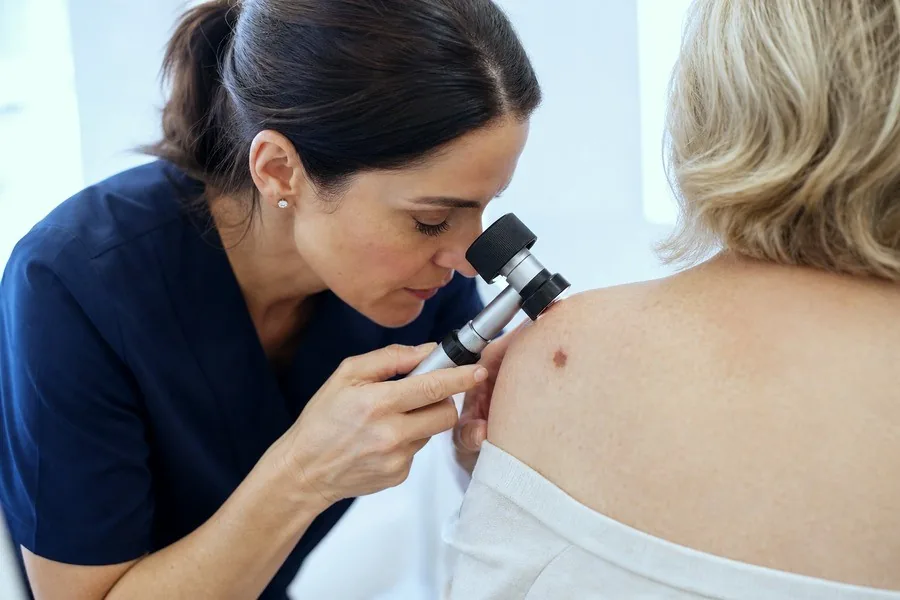
Skin cancer is when cells in the skin start to grow abnormally, usually in areas that have had a lot of sun exposure over the years.
The common types are basal cell carcinoma (BCC) and squamous cell carcinoma (SCC), which tend to grow slowly, and melanoma, which can spread more readily if left. The reassuring part: when a worrying spot is checked early by a dermatologist, most skin cancers are very treatable. You can't diagnose this from a photo or online — a proper skin examination is the only way to know.
Symptoms of skin cancer.
A handy way to remember the warning signs of a mole is ABCDE — but any spot that's new, changing, or simply not behaving like the rest is worth a look.
Why it happens.
Skin cancer is usually linked to cumulative sun exposure over a lifetime, but several things can raise the risk. Having one or more of these doesn't mean you have skin cancer — it just means it's sensible to keep an eye on your skin.
Don't wait for it to settle.
Early assessment helps you get the right treatment sooner. See a specialist if:
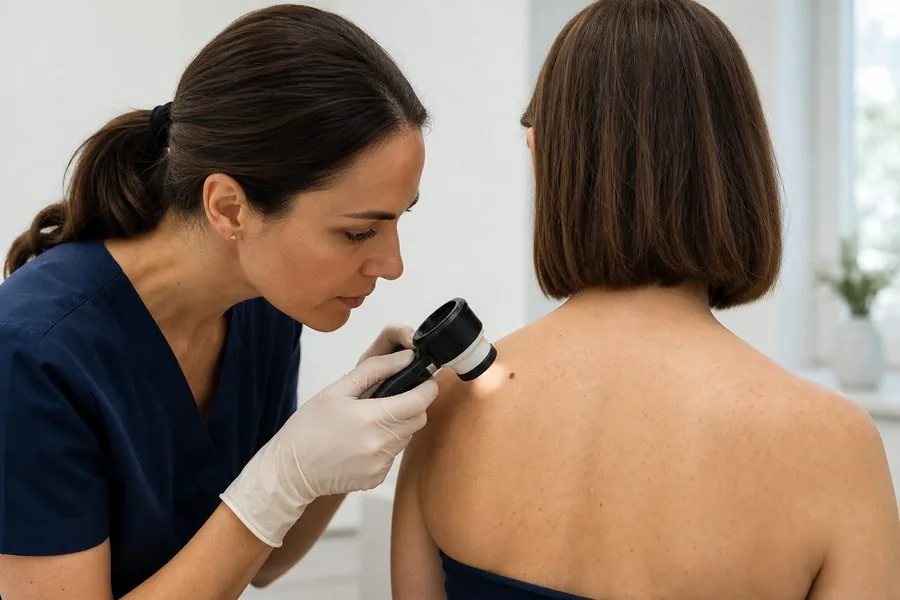

Assessed in person — with dermoscopy and, if needed, a biopsy.
Dr Dalia Alsaadi, Consultant Dermatologist, examines the lesion in person and uses dermoscopy — a magnified, close-up view of the skin — to assess it carefully. If anything looks suspicious, a small sample (biopsy) or removal of the lesion can be arranged, with the tissue sent for laboratory analysis (histology) to give a definite answer. Skin cancer can't be diagnosed from a photo or online; an in-person assessment is the only reliable way to know.
How skin cancer is treated.
We start with a proper assessment, then explain your options clearly — nothing is done without your understanding and agreement.
An in-person consultation and skin examination with dermoscopy to assess the lesion and decide what, if anything, needs doing next.
A small sample of skin is taken and sent to the lab so the lesion can be examined under the microscope for a definite answer.
Surgical removal of a suspected BCC or SCC, including histology, follow-up and wound care so you're looked after start to finish.
Removal of up to three moles or lesions, always sent for histology — never cosmetic-only removal when there's any concern.
Seen in days — not months on a list.
A named specialist, not a junior — all the way through.
Every price published and confirmed in writing.
Seen privately, without the wait.
We bill major UK insurers directly.
Can you tell if a mole is cancer from a photo? +
No. Skin cancer can't be diagnosed from a photo or online — it needs an in-person examination, usually with dermoscopy, and sometimes a biopsy sent for laboratory analysis to be certain.
Do I need a GP referral to be seen? +
No referral is needed. You can book an appointment with our consultant dermatologist directly, usually the same or next week.
Will the mole be sent for testing if it's removed? +
Yes. When there's any concern, anything removed is sent for histology (laboratory analysis) — we don't do cosmetic-only removal of a worrying lesion. The excision fees include histology, and our suspected skin cancer excision also includes follow-up and wound care.
Is skin cancer treatable? +
Many skin cancers, especially BCC and SCC, tend to grow slowly and are highly treatable when found and dealt with early — which is exactly why getting a changing or unusual spot checked promptly matters.
Related reading
Don't put up with it.
Book an assessment with a consultant and get a clear picture — and a plan.