
Dupuytren's Contracture
When one or more fingers start to curl in towards the palm — what it is, why it happens, and how our consultant hand surgeon can help.
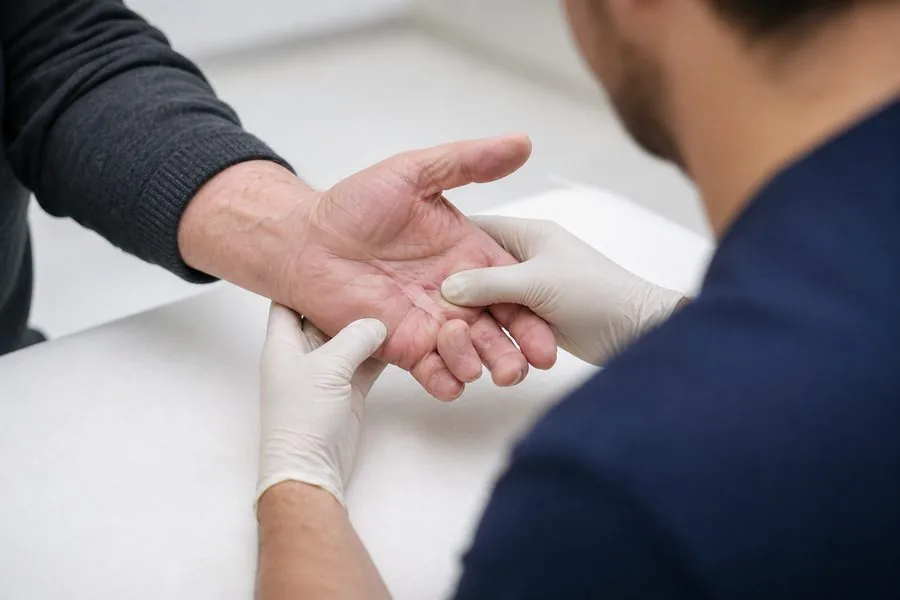
Dupuytren's contracture is a gradual thickening of the tissue under the skin of the palm, which can slowly pull one or more fingers in towards the palm.
It usually develops slowly over months or years and is often painless. Many people live with a mild form that never needs treatment — and when it does start to limit the hand, there are several effective options.
Symptoms of dupuytren's contracture.
It usually develops slowly over months or years, and is often painless.
Why it happens.
The exact cause isn't fully understood, but several things are linked to a higher chance of developing it. It often runs in families and tends to affect both hands.
Don't wait for it to settle.
Early assessment helps you get the right treatment sooner. See a specialist if:
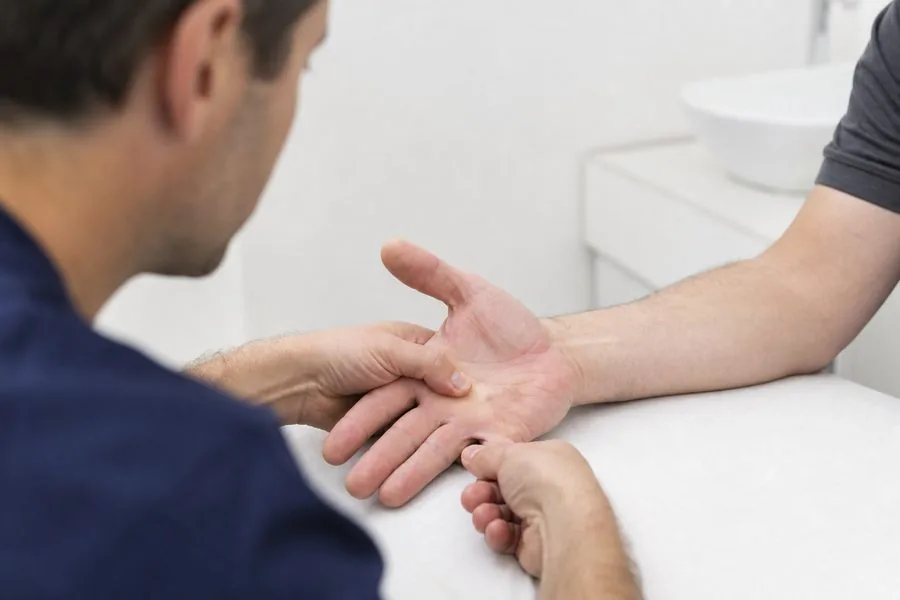

Diagnosed with a simple clinical examination.
Dupuytren's is usually diagnosed in the clinic by examining and feeling the hand — no scans or nerve tests are needed. A common check is the tabletop test: if your hand won't lie flat on a table, it helps confirm the contracture and gauge how far it has progressed. The consultant hand and wrist surgeon will explain what they find and talk through whether treatment is needed now or simply worth monitoring.
How dupuytren's contracture is treated.
We start with the least invasive approach — and many mild cases simply need watching.
If the lump isn't pulling a finger in or limiting your hand, no treatment may be needed — we simply keep an eye on it and review if it changes.
A minimally invasive procedure using a fine needle to divide the tight cord through the skin, helping a curled finger straighten — with little or no cut.
For more advanced contractures, the thickened tissue is removed through a small operation to release the finger. The right option for you is decided together at your consultation.
Seen in days — not months on a list.
A named specialist, not a junior — all the way through.
Every price published and confirmed in writing.
Seen privately, without the wait.
We bill major UK insurers directly.
Is Dupuytren's contracture painful? +
Usually not. The lumps and cords are often painless — it's the loss of finger movement that tends to be the main problem rather than pain.
Will it go away on its own? +
No. Dupuytren's doesn't reverse by itself, but it often progresses slowly and a mild case may never need treatment. We'll advise whether it's best to treat now or simply monitor it.
Can it come back after treatment? +
It can recur over time, as it's an ongoing tendency in the tissue rather than a one-off problem. Your consultant hand and wrist surgeon will discuss what to expect for your particular hand at your consultation.
Do I need a scan or nerve test for Dupuytren's? +
No. It's diagnosed by examining the hand in clinic, so scans and nerve tests aren't usually needed for Dupuytren's itself.
Don't put up with it.
Book an assessment with a consultant and get a clear picture — and a plan.