
Peripheral Neuropathy
Numbness, tingling, burning or weakness in the hands and feet — what peripheral neuropathy is, what lies behind it, and how nerve testing pinpoints the cause.

Peripheral neuropathy is damage to the peripheral nerves — the wiring that carries signals between your brain and spinal cord and the rest of your body.
When these nerves are affected, the messages to and from your feet and hands become faulty. Because those nerves control sensation, power and some autonomic body functions, the effects vary widely — from mild pins and needles to numbness, burning pain or weakness. There are many possible causes, and they don't all behave or need the same approach, so the first step is to confirm whether a nerve problem is present, which nerves are affected and how. Nerve conduction studies and EMG give that answer objectively, rather than relying on symptoms alone.
Symptoms of peripheral neuropathy.
Symptoms typically begin in the feet and can creep upwards over time — frequently in a symmetrical, 'stocking and glove' pattern.
Why it happens.
Peripheral neuropathy is a sign rather than a diagnosis in itself — it means a nerve is being damaged somewhere, and finding why is part of the process. Common causes include the following.
Don't wait for it to settle.
Early assessment helps you get the right treatment sooner. See a specialist if:
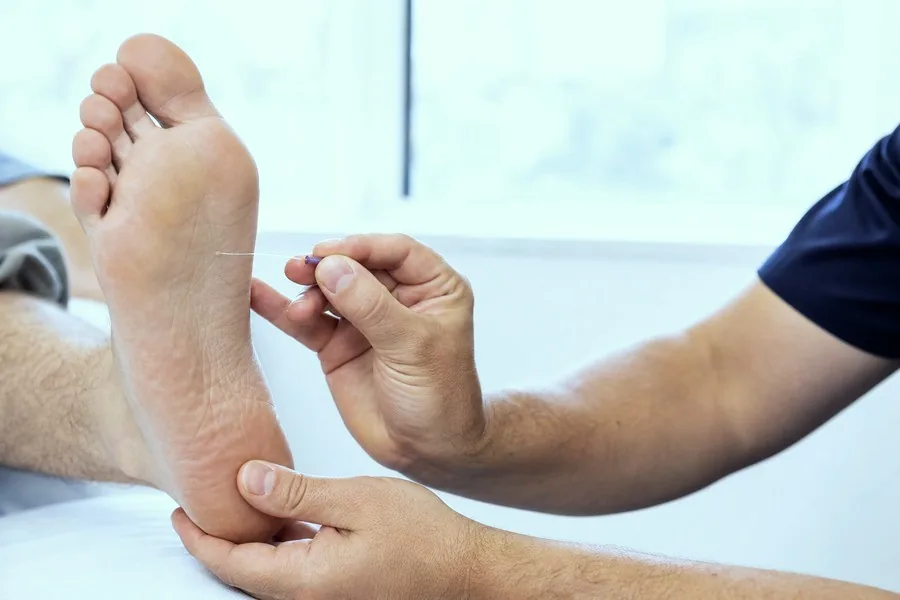

Mapped objectively with nerve conduction studies and EMG.
Peripheral neuropathy is best confirmed not by symptoms alone but by measuring how the nerves are actually working. Dr Arvin Rodrigues, Consultant Clinical Neurophysiologist, performs and interprets the tests himself: a nerve conduction study sends tiny electrical pulses along the nerves to measure how fast and how strongly they conduct, while the EMG uses a fine needle to read the electrical activity in the muscles. Because neuropathy commonly affects both hands and feet, the upper and lower limbs are usually tested together. This maps which nerves are involved, whether the problem affects the nerve fibre or its insulating coating, and how severe it is — the detail that points to the likely cause. When blood tests are required, these can be undertaken on site by the nurse.
How peripheral neuropathy is treated.
Our role here is expert diagnosis: precise nerve testing that gives you and your GP or specialist objective findings to act on. What follows depends on what the testing shows.
A one-to-one appointment with Dr Arvin Rodrigues to review your symptoms and history, examine you, and decide which nerve testing will answer your question most clearly.
Combined testing of the nerves in the arms, hands, legs and feet in a single appointment — performed and interpreted by the consultant to confirm whether neuropathy is present and to map its pattern and severity.
You receive a clear report explaining the findings. Where treatment is needed — such as managing an underlying cause like diabetes or a vitamin deficiency — your results guide that plan, and we make an onward referral to the right specialist where it is appropriate.
Seen in days — not months on a list.
A named specialist, not a junior — all the way through.
Every price published and confirmed in writing.
Seen privately, without the wait.
We bill major UK insurers directly.

What does a nerve conduction study for peripheral neuropathy involve? +
Small electrical pulses are passed along the nerves through pads on the skin to measure how fast and how strongly they conduct, and a fine needle is used for the EMG part to read the muscles' electrical activity. Most people find it very tolerable. Dr Rodrigues carries out and interprets the whole test himself, and because neuropathy usually affects both ends of the body the upper and lower limbs are tested together.
Do I need a GP referral to have nerve testing? +
No — you can book your neurophysiology appointment directly with the clinic, no referral required. If you've had previous tests, blood results or letters about your symptoms, bringing them along helps Dr Rodrigues build the fullest picture.
What does the nerve testing cost? +
A neurophysiology consultation is from £450. Nerve conduction studies with EMG are £450 for the upper limbs, £500 for the lower limbs, and £550 for the upper and lower limbs together — the combined test usually used to investigate peripheral neuropathy. Every price is published upfront.
Can the testing tell me what's causing my neuropathy? +
The study confirms whether a neuropathy is present and maps its type, pattern and severity, which strongly narrows down the likely causes. Pinning down the exact cause can also need blood tests or, occasionally, imaging arranged separately — and your results guide which of those are worthwhile and what the next step should be.
Don't put up with it.
Book an assessment with a consultant and get a clear picture — and a plan.