Can carpal tunnel cause shoulder pain?
Carpal tunnel syndrome is pressure on the median nerve at the wrist. Its typical symptoms are in the hand: tingling, pins and needles and numbness in the thumb, index, middle and part of the ring finger, often worse at night.
Many people with carpal tunnel also describe an ache or a heavy, tired feeling that travels up from the wrist into the forearm. Some feel it reaching the elbow or even higher. This is a recognised feature, because an irritated nerve can produce pain that is felt beyond the exact point where it is squeezed.
Pain that is centred on the shoulder itself, or a stiff and painful neck, is a different matter. While carpal tunnel can occasionally contribute to a vague ache higher up the arm, clear shoulder or neck pain usually points to another source, and it is worth finding out which.
Can carpal tunnel pain radiate to the shoulder and neck?
Aching can spread up the forearm, but carpal tunnel does not usually cause neck pain. When neck pain comes with numbness or tingling in the hand, the more likely explanation is a nerve root being pinched where it leaves the spine in the neck. This is known as cervical radiculopathy.
A trapped nerve in the neck can cause pain running from the neck over the shoulder and down the arm, often with pins and needles in part of the hand. It can be confused with carpal tunnel, and sometimes both are present at once. Clues that the neck is involved include the following.
Can you get carpal tunnel in both hands?
Yes. Carpal tunnel syndrome is commonly found in both hands, even if one side causes more trouble than the other. Often the dominant hand is affected first or more severely, and the other hand follows later or shows milder changes on testing.
Both hands may be affected because the things that raise the risk, such as pregnancy, an underactive thyroid, diabetes, inflammatory arthritis, weight gain and repetitive hand use, tend to act on both wrists at once. When both hands are involved, it is worth discussing these factors with your GP, who may suggest blood tests.
When it might not be carpal tunnel
Numbness in both hands is not always carpal tunnel. Some conditions affect the nerves more widely, for example a peripheral neuropathy, which often starts in the feet. Pressure on the ulnar nerve at the elbow, called cubital tunnel syndrome, typically affects the little finger and outer half of the ring finger.
Separate shoulder conditions, such as problems with the rotator cuff or a frozen shoulder, cause pain and restricted movement in the shoulder joint itself and are not caused by carpal tunnel. They can, however, happen at the same time, which is why an accurate picture of each part of the arm matters.
How a nerve test tells the sites apart
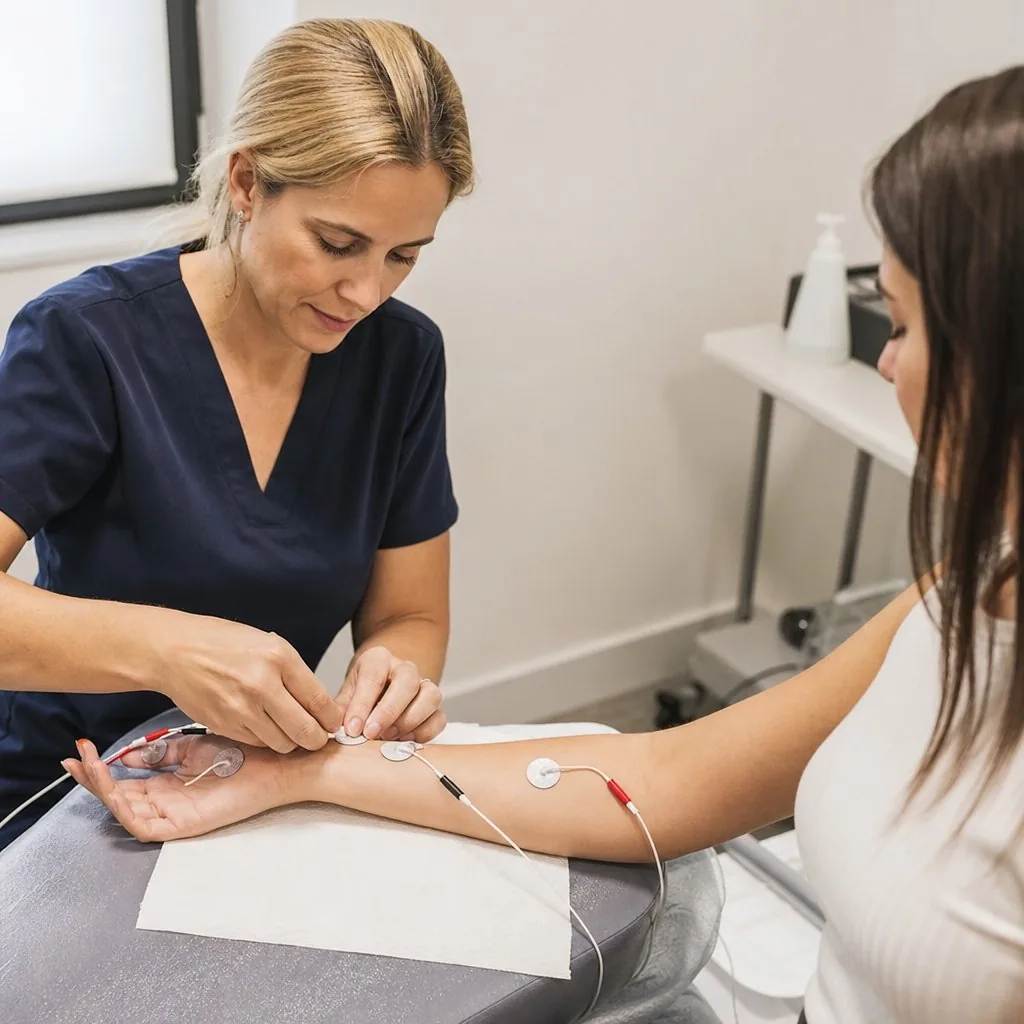
A nerve conduction study measures how signals travel along the nerves of the arm, segment by segment. If the median nerve is slowed only across the wrist, that points to carpal tunnel. If the ulnar nerve slows at the elbow, that suggests cubital tunnel. The EMG part, which records from selected muscles, can show the pattern typically seen when a nerve root in the neck is affected.
Testing both arms is routine where symptoms are in both hands. The results help decide whether treatment should focus on the wrist, the elbow, the neck, or more than one place, and how urgent it is. On the NHS, waits for nerve tests are often long, while privately you can book without a GP referral.
When to see a doctor
See your GP or call NHS 111 if you have neck or arm pain with spreading numbness, weakness in the hand or arm, or symptoms that are steadily getting worse. Seek urgent help if neck pain follows an injury or comes with problems with walking, balance or bladder and bowel control.
Call 999 if numbness or weakness comes on suddenly, especially on one side of the body, or with a drooping face, slurred speech or confusion, as these can be signs of a stroke.
Common questions
Can carpal tunnel cause elbow pain? +
Some people with carpal tunnel feel an ache spreading up the forearm towards the elbow. Pain at the elbow with numbness in the little finger is more often linked to the ulnar nerve at the elbow, so it is worth having both checked.
Is it common to have carpal tunnel in both hands? +
Yes, it is common for both hands to be affected, although one is usually worse. A nerve conduction study normally checks both sides when you have symptoms in both hands.
Could my hand numbness be coming from my neck? +
It could. A pinched nerve in the neck can cause tingling in the hand, often with neck or arm pain. A consultation and nerve test can help work out whether the problem is at the wrist, the neck or both.
Can you have carpal tunnel and a trapped nerve in the neck at the same time? +
Yes, the two can occur together. This is sometimes called a double crush, and it is one reason why a nerve conduction study and EMG are useful before planning treatment.
How much does a nerve conduction study cost at Bridge House Clinic? +
Consultation + nerve conduction study & EMG — upper limbs £450. The consultation and test happen in one visit with Dr Arvin Rodrigues in Rossett, and no GP referral is needed.