Two kinds of claim in plain terms
A personal injury claim usually arises from an accident or the actions of a third party: a road traffic collision, a fall at work, an assault. The medical evidence concentrates on what injury resulted, how it has affected the claimant and what the future is likely to hold.
A clinical negligence claim alleges that a healthcare provider fell below the standard expected and that this caused harm. These cases have two medical strands: whether the care was below standard, which is judged by an expert in the same field as the treating clinician, and whether that care caused the harm complained of.
The distinction matters to the expert because it changes the questions. The tests are the same, but in one case the focus is the effect of an accident, and in the other it is often the sequence of events in treatment, the timing of symptoms and what investigations showed or would have shown.
Personal injury expert witness work
In personal injury cases, a neurophysiologist is usually asked to confirm or exclude a nerve injury, describe its site and severity, and comment on whether the findings fit the mechanism of the accident. Recovery and prognosis are often central, especially where symptoms persist for months.
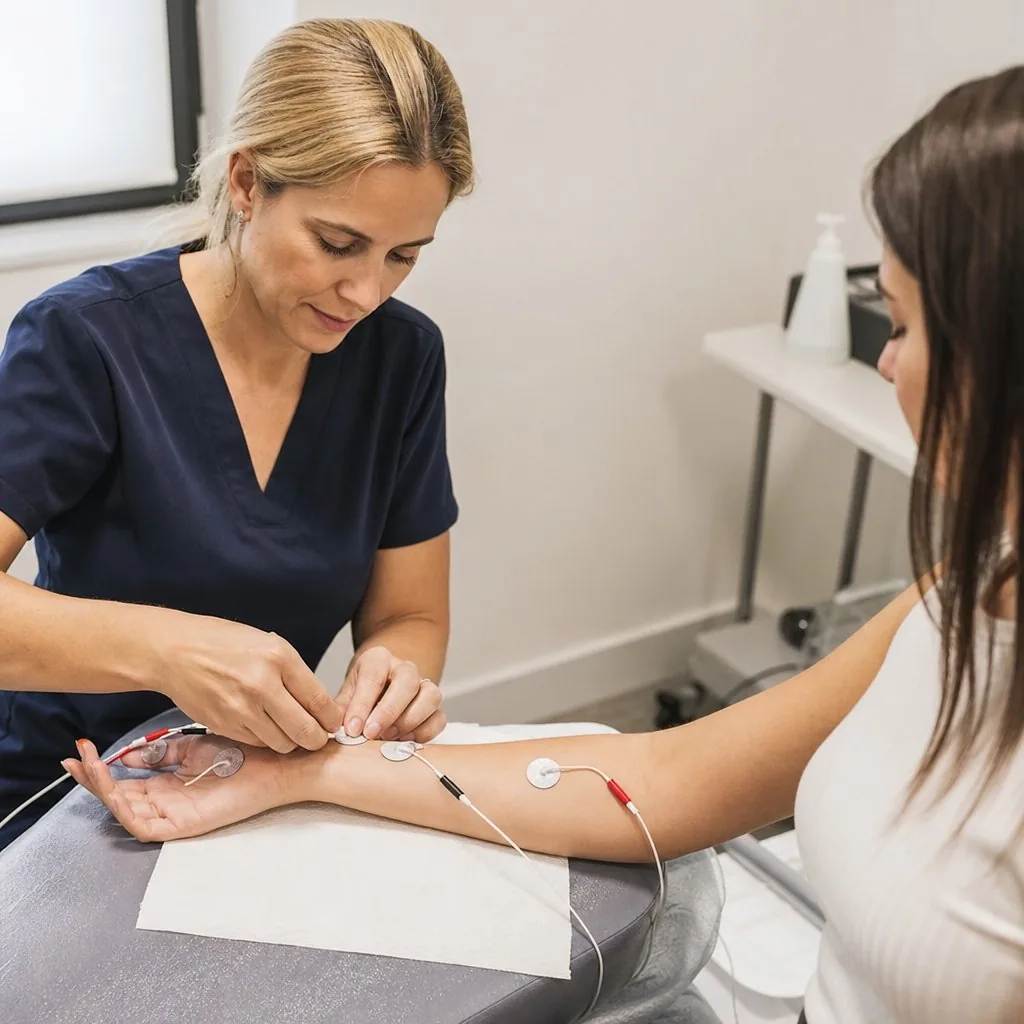
The examination and nerve tests are performed by the reporting expert, so the opinion is built on first-hand findings rather than on a summary of someone else's study.
Defendants and insurers often ask a related question: whether the findings are consistent with the symptoms described, and whether any abnormality could have been present before the accident. The same tests and records help answer that, without assuming the answer either way.
What a medical negligence expert witness in neurophysiology can and cannot say
In clinical negligence, neurophysiology evidence mostly goes to causation and timing. The expert can say whether a nerve injury is present, where it is, roughly when it is likely to have occurred, and whether a nerve test at an earlier stage would probably have shown it.
Opinions on timing draw on the known course of nerve injury. EMG signs of nerve damage take some weeks to develop and then change as the nerve recovers or fails to, so the findings at a given date can be set against when the alleged event happened.
Medico-legal expert witness opinion: the medical questions
Across both kinds of claim, the medico-legal expert witness keeps to questions that neurophysiology can answer. The Part 35 duty to the court applies equally in both, whether the instruction comes from the claimant or the defendant.
Typical case types
The same tests apply across a wide range of instructions. What changes is the question each case asks of them.
Where delayed diagnosis of carpal or cubital tunnel syndrome is alleged, the question is often how severe the nerve compression was likely to be at an earlier date and whether a study then would have shown it. The neurophysiologist can address that; the surgical implications are for a hand surgeon.
Clinical negligence expert fees and instructions from either side
Personal injury reports start from £3,000 and clinical negligence from £6,000, which reflects the larger volume of records usually involved in negligence cases. Every report fee includes two hours' records review, with further review at £400 per hour. Dr Arvin Rodrigues accepts instructions from claimants and defendants, and as a single joint expert. Hand and wrist injury expert reports are also available at the clinic from Miss Kasia Studnicka-Perkin, Consultant Hand & Wrist Surgeon, with fees on request.
This article is general information and not legal advice on any case or a diagnosis. Claimants whose symptoms are changing should see their GP or call NHS 111. Sudden weakness or numbness of the face, arm or leg, slurred speech or confusion needs a 999 call, as these may be signs of a stroke.
Common questions
Can a neurophysiologist comment on whether surgery was done properly? +
No. Breach of duty is for an expert in the surgical specialty concerned. The neurophysiologist describes the nerve injury and its likely timing.
Why do clinical negligence reports cost more? +
They usually involve more records over a longer period. Personal injury reports are from £3,000 and clinical negligence from £6,000, both including two hours' records review.
Is the approach different for defendants? +
No. The examination, tests and standard of reasoning are the same whichever side instructs.
Can the expert say whether earlier testing would have changed things? +
The expert can say whether earlier testing would probably have shown the nerve problem. What would have followed clinically, and whether that matters legally, are for other experts and the court.
Is a desktop report possible? +
Yes, where an examination is not needed. A desktop (records-only) report is £2,000, including two hours of records review; additional records review is invoiced at £400 per hour.
Can a neurophysiologist give evidence about EEG findings? +
Yes, where the question concerns what an EEG shows or would have shown. Dr Rodrigues has a special interest in epilepsy diagnostics. Questions about the overall diagnosis and management of epilepsy may also need a neurologist.