Can damaged nerves repair?
The nerves in the arms, hands, legs and feet, known as peripheral nerves, have a genuine ability to heal. This is different from the brain and spinal cord, where repair is much more limited. Whether and how well a peripheral nerve recovers depends on what kind of damage has happened, how far along the nerve it is, how long it has been under pressure, and your general health.
Doctors usually describe nerve injuries in three broad grades. The names sound technical, but the ideas behind them are straightforward.
The three grades of nerve injury, in plain words
Think of a nerve as a bundle of electrical cables. Each cable has a central wire, which carries the signal, wrapped in insulation, and the bundle sits inside a protective outer sheath.
Neurapraxia is the mildest grade. The insulation is disturbed but the wires are intact, so signals are blocked or slowed at the injured spot. This is common after short-lived pressure, such as sleeping awkwardly on an arm. Recovery is usually good, often within days to a few weeks once the pressure is relieved.
Axonotmesis is a more significant injury. The wires themselves are damaged, but the outer sheath is still in place. The part of the wire beyond the injury breaks down, and new wire has to grow back along the sheath, which acts as a guide. Recovery is possible but slow.
Neurotmesis is the most severe grade. The whole nerve, including its sheath, is cut or torn. Without a guide, regrowth is unlikely to reach its target on its own, and a surgical opinion from a specialist team is usually needed. Bridge House Clinic does not carry out nerve surgery, but a nerve test can help show whether such a referral is needed.
How long does nerve damage take to heal?
For neurapraxia, recovery is mostly a matter of the insulation repairing itself, so it is often measured in days to weeks.
When the wiring has to regrow, the commonly quoted rate is roughly one millimetre a day, or about an inch a month, although this varies between people and slows over long distances. The further the injury is from the muscle or skin it supplies, the longer recovery takes. An injury near the wrist may show progress within weeks to months, while one high in the arm or leg may take many months to reach the hand or foot.
Even after the nerve has regrown, strength and feeling can continue to improve gradually as the muscles and the brain adapt. Some people are left with a degree of numbness or weakness, particularly after severe or long-standing injuries.
What helps recovery
Recovery is largely the nerve's own work, but some things can support it. Relieving ongoing pressure on the nerve is the most important step for entrapments such as carpal tunnel or cubital tunnel. Your GP or specialist may also suggest the following.
Patience matters too. Because regrowth is slow, it is common to go weeks without noticing change, and that does not necessarily mean the nerve is not recovering.
Why a nerve test matters
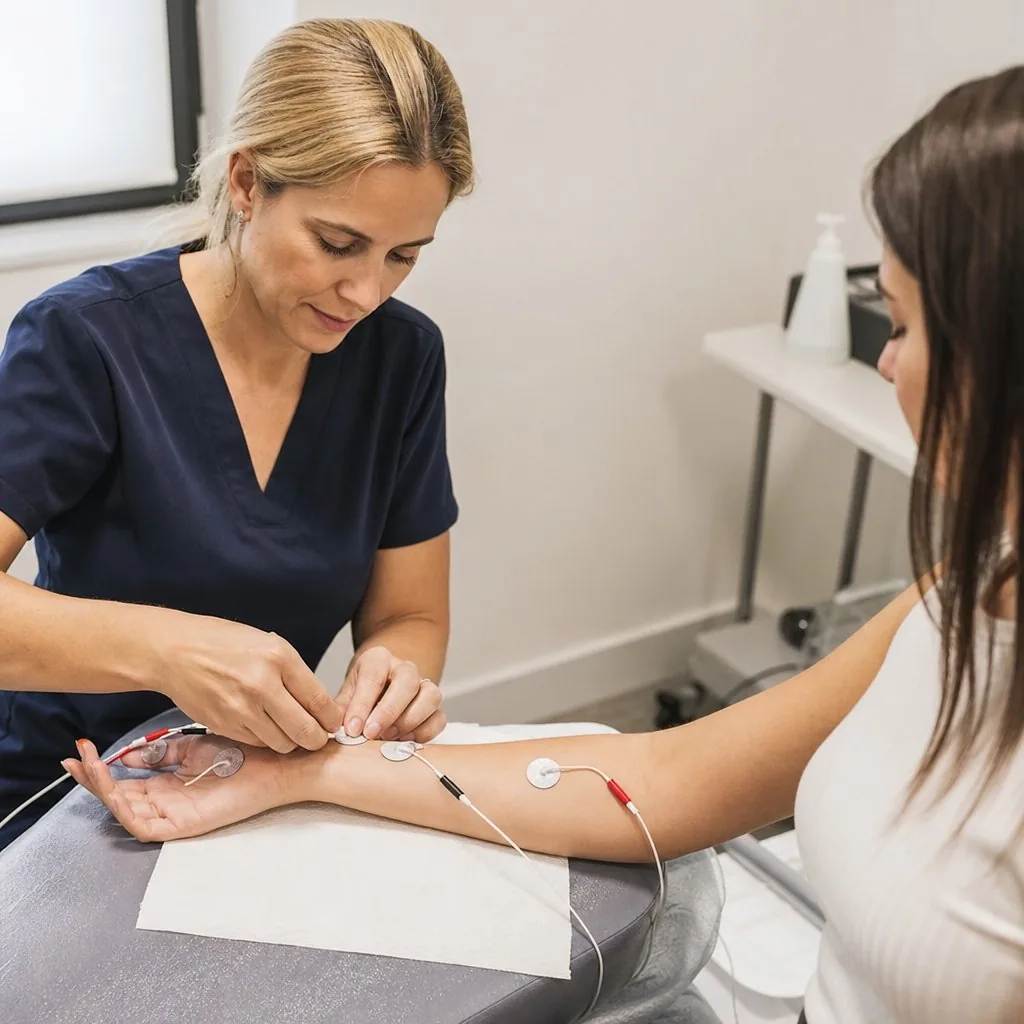
From the outside, a mildly bruised nerve and a seriously damaged one can look similar in the early days, because both cause numbness and weakness. A nerve conduction study and EMG measure how the nerve and its muscles are actually working, which helps estimate which grade of injury is present and how much of the nerve is affected.
Repeating the test after an interval can track recovery. EMG can pick up early signs of regrowing nerve fibres reaching a muscle, sometimes before any movement is visible. This helps you and your doctors judge whether recovery is on course or whether a further opinion is needed. Timing matters: some changes only show clearly a couple of weeks or more after an injury, and Dr Rodrigues can advise when testing will be most informative.
Waiting times, and when to seek help
On the NHS, nerve conduction studies are arranged through a hospital referral and waits can often be months. At Bridge House Clinic in Rossett, near Chester, you can book directly without a GP referral and see Dr Arvin Rodrigues for a consultation and test in one visit.
This article is general information and not a diagnosis. After a cut or wound with numbness, or any injury causing loss of movement, seek prompt medical care through your GP, NHS 111 or an urgent treatment centre. Call 999 for sudden weakness or numbness of the face, arm or leg, or slurred speech, which may be a stroke.
Common questions
Can nerve damage be repaired? +
Peripheral nerves in the arms and legs can often repair themselves, especially after milder injuries. Recovery depends on the grade of damage, its location and how long the nerve has been affected. A completely divided nerve usually needs a specialist surgical opinion.
How long does nerve damage take to heal? +
Mild pressure injuries often recover in days to weeks. Where nerve fibres have to regrow, they do so at roughly a millimetre a day, so recovery can take months depending on the distance involved.
Is nerve damage permanent? +
Not always. Many nerve injuries recover well, but severe or long-standing damage can leave some numbness or weakness. Early assessment helps identify injuries that need further treatment.
Can a nerve conduction study show if a nerve is healing? +
Yes. Repeating the study after an interval can show whether signals are improving and whether regrowing nerve fibres are reaching the muscles, sometimes before you notice any change.
Do you treat nerve injuries surgically? +
No. Bridge House Clinic provides the diagnostic nerve tests. If the results suggest a surgical opinion is needed, Dr Rodrigues will explain this and the report can be shared with your GP to arrange referral.