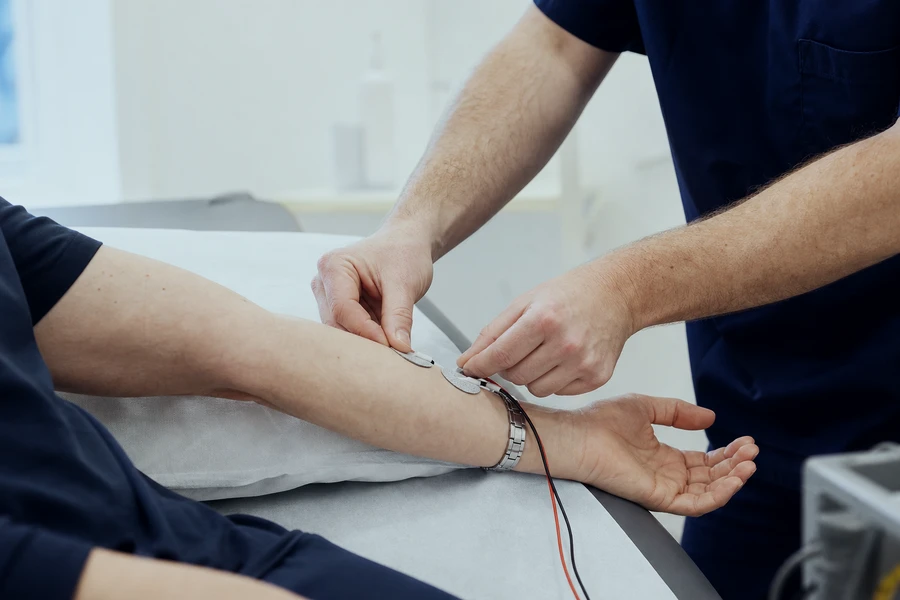
What a nerve conduction study feels like
A nerve conduction study (NCS) uses small sticky sensors on the skin and a hand-held probe that delivers very short electrical pulses over a nerve. Each pulse lasts a fraction of a second. Most people describe it as a tap, a flick or the feeling of a static shock from a car door, and the muscle under the sensor may twitch on its own for a moment.
The strength of the pulse is turned up gradually until the nerve gives a clear, full response, so you are never surprised by a sudden jolt. If a particular point feels sharp, say so — the pulse can often be repositioned or the pace slowed down, and you can ask for a pause at any time.
Nothing is left in the body and there is no lasting after-effect from the pulses themselves. Once a reading is done, the sensation stops straight away.
Are EMG tests painful?
Electromyography (EMG) is often done alongside the nerve study. A very fine, single-use needle is placed into a muscle to listen to its electrical activity, first while you relax and then while you tighten it gently. It is thinner than the needle used for a blood test, and no electricity is passed through it.
Most people feel a sharp scratch as the needle goes in and a dull ache while it is in the muscle, which settles once it is removed. Only a few muscles are usually checked, chosen to answer the specific question raised by your symptoms. Not everyone needs an EMG; Dr Rodrigues decides on the day whether it will add useful information.
Afterwards a muscle can feel a little tender, like after a bruise, for a day or so. A small spot of bleeding or a minor bruise at the site is possible, which is why it helps to tell the clinic beforehand if you take blood-thinning medication.
Can you fail a nerve conduction test?
No. People sometimes search for how to fail a nerve conduction test, usually because they are worried about getting it wrong. There is nothing to pass or fail. The machine records how fast and how strongly signals travel along the nerve, and the results simply describe what is happening.
You cannot make your nerves look better or worse by trying harder, and you do not need to study or practise. During the EMG you may be asked to relax a muscle or tighten it gently, and Dr Rodrigues will guide you through each step. If you find it difficult to keep still or relax, that is common and the test can be paced to suit you.
A normal result is a useful answer in its own right. It can rule out a trapped nerve and point towards other causes of tingling or pain, such as a problem in a joint, a tendon or circulation.
How long does a nerve conduction study take?
The testing itself usually takes somewhere between 30 minutes and an hour. The exact time depends on how many nerves need checking — one wrist takes less time than both arms and both legs — and on whether an EMG is needed.
At Bridge House Clinic the visit begins with a short consultation. Dr Rodrigues asks about your symptoms and examines the area so that the study can be tailored to your problem rather than run as a fixed routine. Allow a little extra time for this and for talking through the findings afterwards.
Getting ready, and can I drive afterwards?
Preparation is simple. Wash and dry the skin on the day and avoid moisturiser, creams or oils, because they stop the sensors making good contact. Wear loose sleeves or trousers that roll up easily. Cold hands and feet slow nerve signals down, so on a chilly day it helps to arrive a few minutes early and warm up.
Let the clinic know in advance if you have a pacemaker or another implanted device, take blood-thinning medication, or have lymphoedema or a skin infection in the area to be tested, as these can change how the study is done.
There is no sedation and nothing that affects alertness, so you can normally drive yourself home and return to work or your usual activities the same day.
Waiting times, and when to get help urgently
On the NHS, nerve conduction studies are usually arranged through a hospital referral, and the wait can often be months. Privately, you can book the test directly, without a GP referral, and there is no NHS waiting list. If you do have a letter from your GP or a specialist, bring it along, as it helps focus the study.
This article is general information and is not a diagnosis. If your symptoms are getting worse, see your GP or call NHS 111. Call 999 straight away for sudden weakness or numbness in the face, arm or leg, slurred speech or confusion, as these can be signs of a stroke and need emergency care, not a nerve test.
Common questions
Does a nerve conduction study hurt? +
Most people find it uncomfortable rather than painful. The electrical pulses feel like a quick tap or flick and stop as soon as each reading is taken. You can ask for a pause at any point.
Is the EMG needle like an injection? +
No medicine is injected. The EMG needle is very fine and only records the electrical activity of the muscle. Most people feel a sharp scratch and a dull ache that eases once it is removed.
Can I fail a nerve conduction test? +
No. It is a measurement, not an exam, so there is nothing to pass or fail and nothing you can do to change the result. A normal result is still useful, because it helps rule a trapped nerve in or out.
How long does a nerve conduction study take? +
The testing usually takes between 30 minutes and an hour, depending on how many nerves and muscles need checking. Allow some extra time for the consultation beforehand and the explanation of findings afterwards.
Can I drive after a nerve conduction study? +
Yes, normally. There is no sedation and nothing that affects your alertness, so most people drive home and carry on with their day as usual.
How much does it cost? +
Consultation + nerve conduction study & EMG — upper limbs £450, lower limbs £500, and upper and lower limbs £550. No GP referral is needed to book.