What is a neurophysiologist?
Clinical neurophysiology is a medical specialty in its own right. Consultant clinical neurophysiologists are doctors listed on the GMC specialist register. Their focus is not on scans or surgery but on function: how well the brain, spinal cord, nerves and muscles generate and carry electrical signals.
In practice, a neurophysiologist uses a set of tests that record those signals. The results help confirm or rule out a diagnosis, locate where a problem sits, and judge how severe it is.
Neurophysiologist vs neurologist
A neurologist assesses patients with conditions such as epilepsy, migraine, multiple sclerosis, Parkinson's disease and stroke, takes a history, examines the nervous system, arranges investigations and manages treatment over time. Neurologists often refer patients to clinical neurophysiology for tests.
A clinical neurophysiologist is usually the specialist who carries out and reports those tests. The two roles overlap in knowledge but differ in emphasis: one leads on clinical diagnosis and long-term care, the other on measuring how the nervous system is working. It is common to see both during the course of one problem.
What does a neurophysiologist do at your appointment?
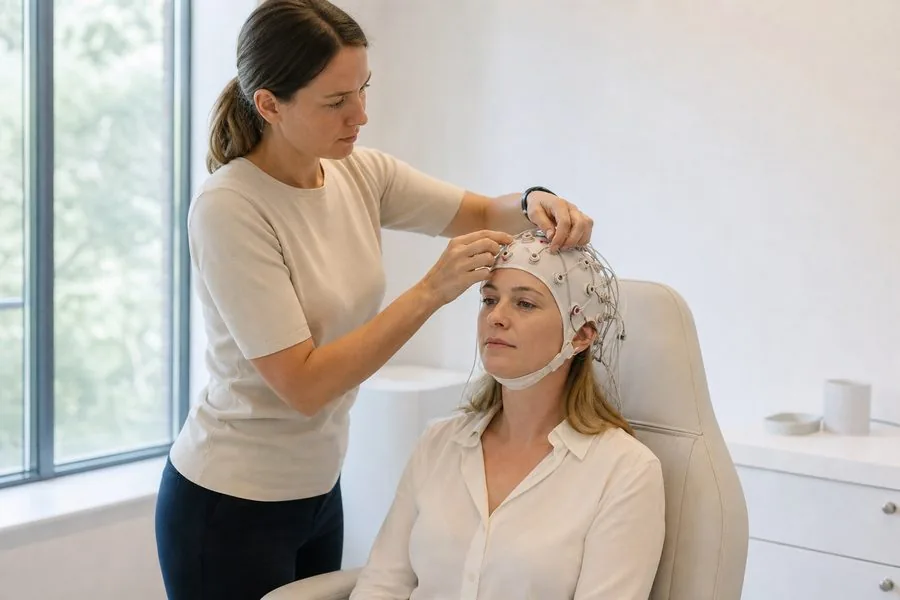
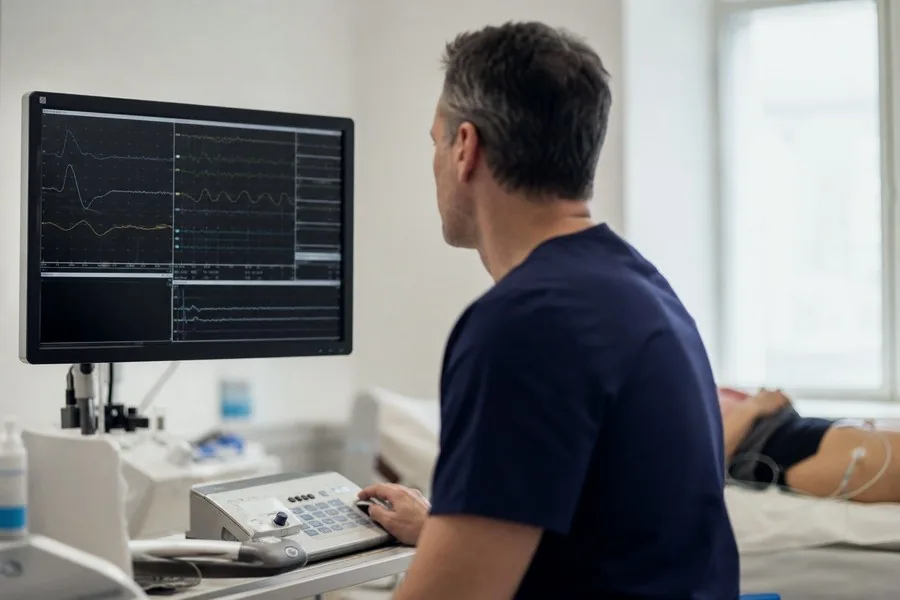
An appointment with a neurophysiologist starts with questions about your symptoms and a short, focused examination. This shapes the test, so that it answers your particular question rather than following a fixed routine. For a nerve conduction study, small sensors go on the skin and brief pulses are given along the nerve; EMG uses a fine needle in selected muscles.
At Bridge House Clinic the same consultant performs and interprets the test. That means the person examining you is also the person reading the results, and the findings can be explained to you before you leave. The written report sets out what was tested, what was found, where any problem lies and how significant it appears, and it can be shared with your GP or specialist.
When you need which specialist
If your main problem is tingling, numbness, pain or weakness in an arm or leg, a clinical neurophysiologist can often test the nerves directly and show whether there is a trapped nerve, a nerve root problem or a more widespread neuropathy. You do not need a GP referral to book privately.
If your concern is headaches, a possible diagnosis of multiple sclerosis or Parkinson's disease, memory problems, or ongoing management of a neurological condition, a neurologist is the right first specialist. They may then request tests such as an EEG or nerve study as part of the work-up.
How consultant clinical neurophysiologists train in the UK
In the UK, a consultant clinical neurophysiologist first qualifies in medicine, then completes general medical training as a junior doctor, and then undertakes specialty training in clinical neurophysiology. That training covers the nervous system in health and disease, as well as performing and interpreting the full range of tests. A doctor joins the specialist register after completing that training, or an equivalent recognised by the GMC, and can then practise as a consultant.
Dr Arvin Rodrigues is a Consultant Clinical Neurophysiologist (GMC 6079103). He trained at Karolinska University Hospital in Stockholm, holds an MSc in epilepsy from King's College Hospital, London and previously worked at the Walton Centre in Liverpool. He has 15 years at consultant grade, with special interests in nerve conduction studies and EMG, traumatic nerve injuries, epilepsy diagnostics and injection treatment for dystonia.
Our clinic, and when to seek urgent help
Bridge House Clinic does not have a neurologist. What we offer is clinical neurophysiology: consultation with nerve conduction studies and EMG in one visit, EEG recordings, and injection treatment for dystonia, all with Dr Rodrigues. If you need a neurologist, your GP can refer you, and our test reports can be shared with them.
This article is general information and not a diagnosis. See your GP or call NHS 111 if you are unsure which specialist you need. Call 999 for sudden weakness or numbness of the face, arm or leg, slurred speech or confusion, or for a seizure lasting more than five minutes.
Common questions
What is a neurophysiologist? +
A doctor who specialises in measuring the electrical function of the brain, nerves and muscles, using tests such as nerve conduction studies, EMG and EEG.
Are clinical neurophysiologists doctors? +
Yes. Consultant clinical neurophysiologists are medically qualified doctors on the GMC specialist register, not technicians.
Is a neurophysiologist the same as a neurologist? +
No. A neurologist diagnoses and manages neurological conditions clinically; a neurophysiologist performs and interprets tests of nervous system function. They often work together.
Can I see a neurophysiologist without a referral? +
Privately, yes. You can book a nerve conduction study, EMG or EEG at Bridge House Clinic directly, with no NHS waiting list.
Does Bridge House Clinic have a neurologist? +
No. The clinic offers clinical neurophysiology with Dr Rodrigues. If you need a neurologist, your GP can refer you, and test reports can be shared with them.