Who is suitable
Injection treatment suits people with focal dystonia, where one area of the body is affected. At Bridge House Clinic the treated areas are the neck, the eyelids, the jaw and the hand or limb. Whether it is right for you is confirmed at the assessment, which looks at your symptoms, other conditions and previous treatment.
Treatment is given by Dr Arvin Rodrigues, Consultant Clinical Neurophysiologist, who has a special interest in dystonia injection therapy. No referral is needed.
Your dystonia injections appointment, step by step
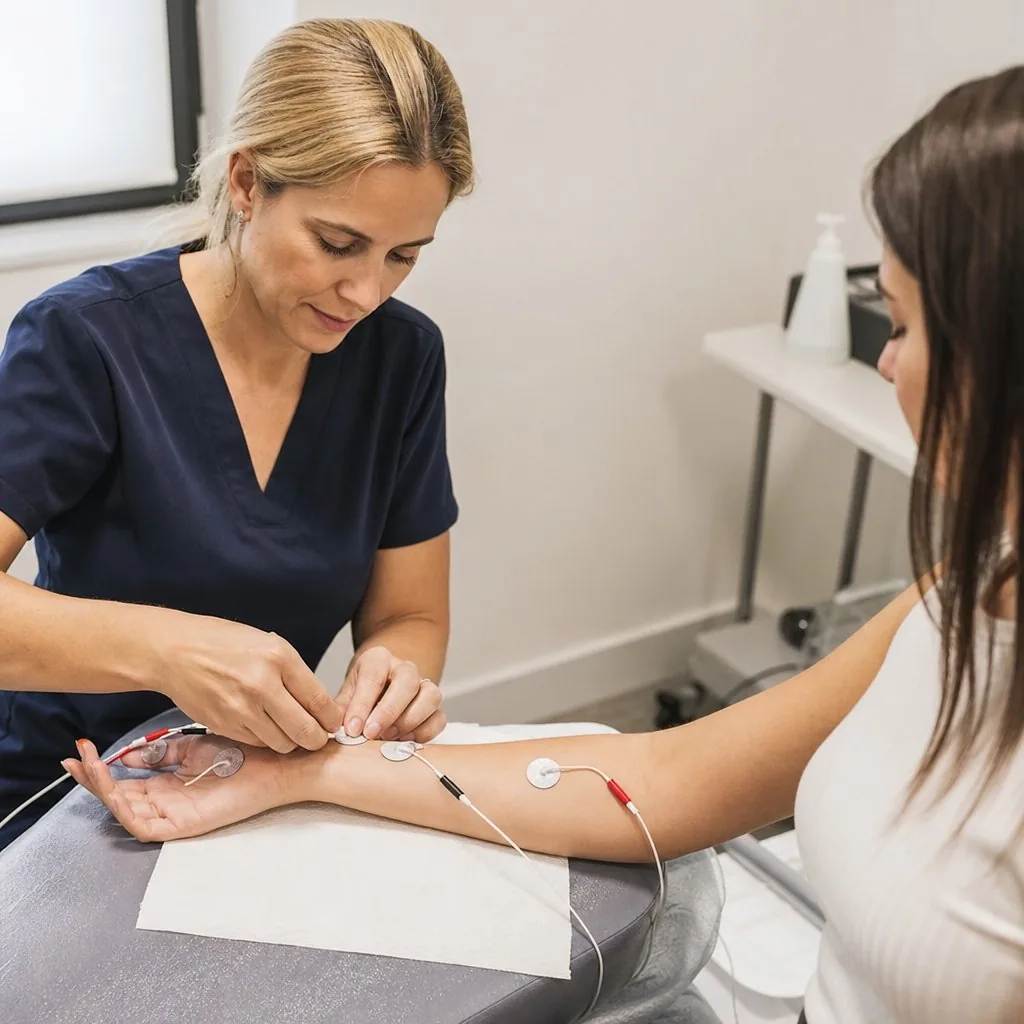
The visit begins with a conversation about how the movements affect you, what makes them better or worse and what you would most like to improve. Dr Rodrigues then watches the movement closely, at rest and during the actions that provoke it, and examines the muscles involved.
From this, he chooses which muscles to treat and how much to give each one. Muscle selection is guided by the symptom pattern and EMG: for deeper or harder-to-identify muscles, a fine EMG needle can listen to the muscle's activity to confirm the right spot. The points are marked on the skin and cleaned.
Several small injections are then given with a fine needle. Most people describe a brief sting at each point. The injections themselves take only a few minutes; allow longer for the whole appointment.
Aftercare is simple. You may be asked not to massage or press on the treated area for the rest of the day, and to carry on with normal light activity. Before you go, the plan for the next visit is agreed, including when to come back and how the dose will be reviewed in light of your response.
How long do dystonia injections take to work?
Nothing changes straight away. The effect builds over several days and peaks within a couple of weeks. It then lasts for a period of months before gradually wearing off, at which point symptoms return and the next treatment is planned.
Because response differs between people and between muscles, the first treatment is partly a guide. Telling the clinic how quickly it worked, how much it helped and when it faded allows the plan to be refined.
How often are dystonia injections repeated?
Treatment is usually repeated every few months, timed for when the benefit is wearing off. Leaving a gap between treatments is standard practice. At each review the dose is adjusted each visit, and muscles may be added or left out depending on how the last round went.
Before you leave, you agree the return interval and how the dose will be reviewed. Keeping a simple diary of when the effect began and ended is very useful.
Side effects of dystonia injections
Most side effects come from the treatment spreading slightly to nearby muscles and making them temporarily weak. They are related to the area treated and wear off as the treatment does. Your consultant explains the specific risks for the muscles treated before you decide.
Bruising or soreness at the injection points is common and settles within days. A few people feel tired or slightly flu-like for a day or two.
What to bring, cost and getting home
Bring details of any previous injection treatment: the product, the dose and how long it lasted. Mention if you take blood thinners, as bruising is more likely. A list of other medicines and conditions is helpful too.
Injection treatment for dystonia from £450. The final cost depends on the number of muscle sites treated and is confirmed at the appointment. Most people can drive home afterwards; if your eyelids were treated and your vision is affected, do not drive until it clears.
This article is general information and not a diagnosis. If you develop trouble swallowing or breathing after treatment, contact the clinic, see your GP or call NHS 111; call 999 if breathing is difficult, or for sudden weakness of the face, arm or leg, slurred speech or confusion.
Common questions
Does the injection treatment hurt? +
Most people feel a short sting at each point, and a fine needle is used. Any soreness usually passes within a day or two.
Can I go back to work the same day? +
Usually, yes. There is no sedation, and most people return to normal activities, though it is sensible to avoid rubbing the treated area that day.
What if the treatment didn't help much? +
Tell the clinic. The muscles and dose are reviewed and adjusted each visit, and EMG may help locate over-active muscles more precisely next time.
Is dystonia treatment the same everywhere on the body? +
The principle is the same, but the muscles, doses and possible side effects differ between the neck, eyelids, jaw and hand.
Is injection the only dystonia treatment? +
No. Depending on the type of dystonia, physiotherapy, retraining, changes to daily tasks and prescription medicines a neurologist may use all have a role. Injection treatment is often the main option for focal dystonia.
Do I need a referral? +
No. You can book directly with Dr Rodrigues for assessment and treatment.