What is nerve conduction testing?
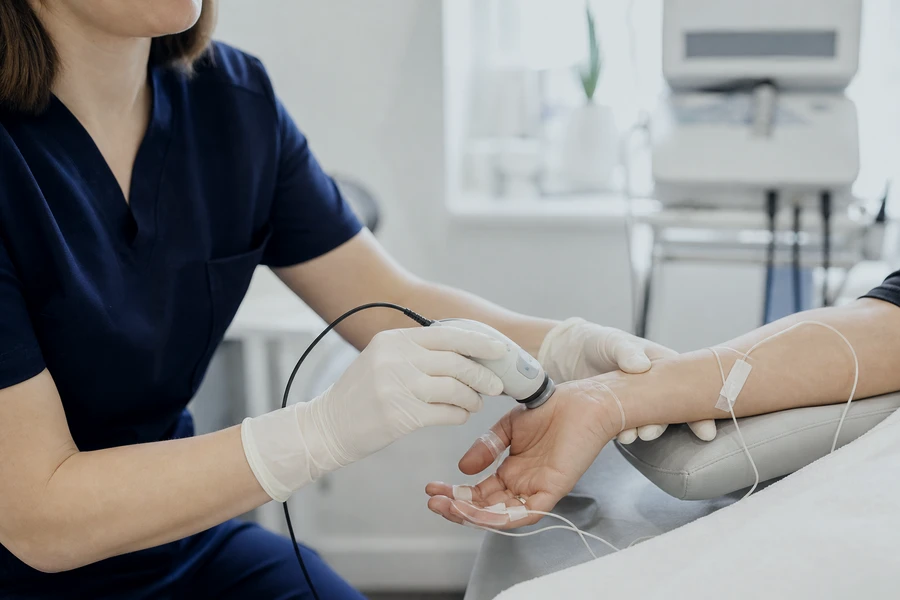
Nerves work by carrying tiny electrical signals between your brain, spinal cord, skin and muscles. Nerve conduction testing measures those signals directly. Small sensors are placed on the skin over a nerve or muscle, and a probe gives a brief electrical pulse at another point along the same nerve. A computer then records how long the signal takes to arrive and how large it is when it gets there.
From these readings it is possible to work out the speed at which a nerve conducts and the strength of its response. Comparing different stretches of the same nerve shows whether there is a slowdown at a particular spot, such as the wrist or the elbow, or whether many nerves are affected in a more widespread way.
The test is a measurement of function. It complements scans, which show structure, because a nerve can look normal on a scan and still not be working properly.
What is an EMG test?
Electromyography, or EMG, looks at the muscles rather than the nerves. A very fine needle electrode is placed into a muscle and records its electrical activity, first at rest and then while you tighten it gently. A healthy muscle is quiet at rest and produces a recognisable pattern when it works.
When the nerve supplying a muscle has been damaged, the muscle's electrical activity changes in characteristic ways. EMG can therefore show whether nerve damage has reached the muscle, how long it may have been going on, and whether there are signs of the nerve recovering. It can also help identify conditions that start in the muscle itself.
NCS vs EMG: what is the difference?
The two tests answer different parts of the same question, which is why they are often done in one sitting. The nerve conduction study looks at the nerve's wiring; the EMG looks at whether the muscle at the end of that wiring is affected.
Not everyone needs both. For a straightforward wrist problem, the nerve study may give a clear answer on its own. Where weakness, a possible trapped nerve in the neck or back, or a more general nerve condition is suspected, EMG often adds important detail.
What does a nerve conduction test diagnose?
Nerve conduction studies and EMG are used to investigate numbness, tingling, pins and needles, burning pain or weakness in the arms, hands, legs or feet. The pattern of the results helps separate one cause from another, which matters because different causes are managed differently.
Among the conditions the tests commonly help to confirm or rule out are the following.
How the results are read
Each measurement is compared with expected values for the nerve being tested, taking into account things like your age, height and skin temperature. A single borderline figure does not usually mean much on its own; it is the overall pattern across several nerves that tells the story.
At Bridge House Clinic the same consultant performs and interprets the test. Dr Arvin Rodrigues, a Consultant Clinical Neurophysiologist, discusses the findings with you and a written report follows. The report usually describes whether there is a nerve problem, where it is, whether it mainly affects the insulating coating of the nerve or the nerve fibres themselves, and how severe it appears.
A normal result is also valuable. It can make a trapped nerve less likely and point towards other explanations, such as a joint, tendon or circulation problem, so that the right next step can be planned with your GP or specialist.
Getting a test, and when to seek help
On the NHS, nerve conduction studies are arranged through hospital referral and waits can often be months. Privately, you can book directly without a GP referral and with no NHS waiting list. The fee includes a short consultation and the test in one visit.
This article is general information and not a diagnosis. If your symptoms are worsening, see your GP or call NHS 111. Sudden weakness or numbness of the face, arm or leg, difficulty speaking or confusion can be signs of a stroke — call 999 immediately.
Common questions
What is the difference between a nerve conduction study and an EMG? +
A nerve conduction study measures how well a nerve carries signals using surface sensors and brief pulses. An EMG uses a fine needle to record activity inside a muscle. They are often done together because each answers a different part of the question.
Will I need both tests? +
Not always. Dr Rodrigues tailors the study to your symptoms and only adds EMG where it is likely to give useful information. This is decided during the visit.
Can a nerve conduction study show a trapped nerve in the neck? +
It can help. A trapped nerve root in the neck or back (radiculopathy) often shows up more clearly on EMG, while the nerve study helps exclude a problem further down the arm or leg. Scans and examination are often considered alongside the results.
Does a normal result mean nothing is wrong? +
It means the nerves tested are working within the expected range. That is useful information, because it points the search towards other causes. It does not dismiss your symptoms, and your GP or specialist will consider the result together with everything else.
Do I need a referral? +
No. You can book a private nerve conduction study directly. If you have a letter from your GP or a specialist, bring it, as it helps focus the test.