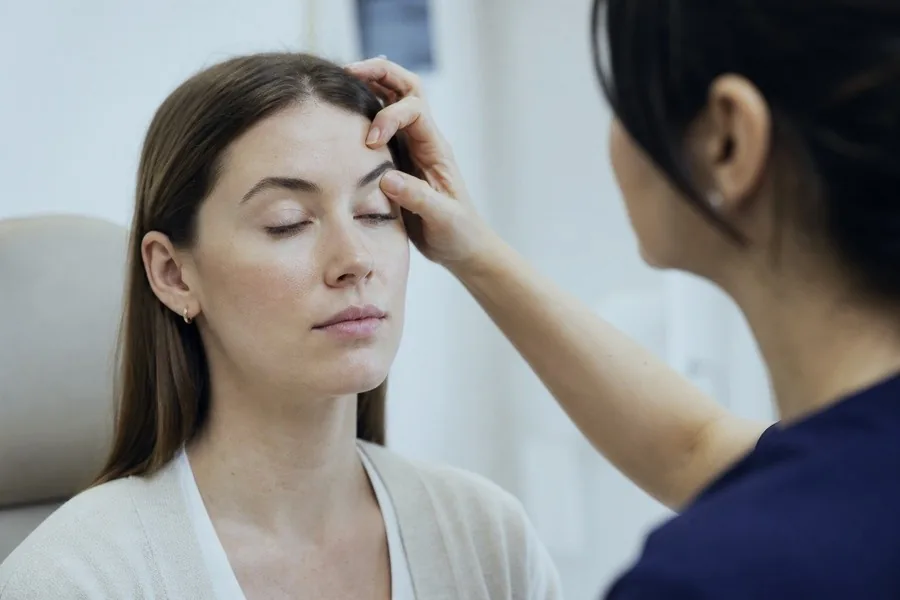
Eye twitching vs blepharospasm
Almost everyone has felt an eyelid flicker at some point. That fine, rippling twitch of one lid, known as eyelid myokymia, is common and harmless. It tends to appear with tiredness, stress, too much caffeine or long hours at a screen, and it fades on its own over days or weeks. It does not close the eye.
Blepharospasm is different in kind, not just in degree. Both eyes are involved, and the lids are pulled firmly shut rather than flickering. The closures can last a second or two or much longer, and they come back again and again. In severe cases a person can be functionally blind even though nothing is wrong with the eyes, simply because the lids will not stay open.
Blepharospasm symptoms
It often begins quietly, with more blinking than usual, a feeling of grit or irritation and a sense that the eyes are tired. Over months the blinks become harder and longer. Many people notice that bright light, wind, reading and driving make it worse, while talking, humming, looking down or touching the side of the face can briefly ease it.
Light sensitivity is very common and can be one of the most troublesome features. Some people start wearing sunglasses indoors. The symptoms usually fade during sleep and are often milder first thing in the morning, before building through the day.
What causes blepharospasm?
Benign essential blepharospasm is the name used when no other cause is found, which is the usual situation. 'Benign' means it is not life-threatening; 'essential' means it arises on its own. It is thought to come from a change in the brain circuits that control movement, the same circuits involved in other focal dystonias. It most often starts in middle age or later and is seen more often in women.
Dry eye and light sensitivity do not cause the condition, but they can act as triggers that set it off and keep it going. Less commonly, blepharospasm is secondary to something else, such as a reaction to certain medicines, Parkinson's disease or another condition affecting the brain. When the lower face and jaw are involved too, the pattern is sometimes called Meige syndrome.
How it is diagnosed
There is no single test for blepharospasm. The diagnosis is clinical, made by watching the pattern of eyelid closure and hearing how it behaves day to day. An ophthalmologist checks the surface of the eye to rule out, or treat, dry eye, inflammation of the lids and other eye problems that can cause excessive blinking. A neurologist may be involved where a secondary cause needs to be considered.
Brain scans are not needed for most people, but may be arranged if the features are unusual or other neurological signs are present.
Blepharospasm treatment
Simple measures help many people: lubricating eye drops for dry eye, tinted glasses (some find rose-tinted lenses useful) and avoiding glare where possible. These rarely control the spasms on their own, but they make the eyes more comfortable.
The main treatment in the UK is injection treatment that relaxes the over-active muscles for a period of months. Small injections are placed in the muscles around the eyes, and the course is repeated every few months. What a treatment visit involves is covered in detail on the dystonia injections page. Surgery to remove part of the eyelid muscle is reserved for the rare person who does not respond.
At Bridge House Clinic, Dr Arvin Rodrigues, Consultant Clinical Neurophysiologist, assesses and treats eyelid dystonia. Injection treatment for dystonia from £450, with no referral needed.
Outlook, and when to get urgent help
Blepharospasm is usually a long-term condition, and it can gradually become more noticeable over the first few years before settling into a stable pattern. With regular treatment many people find reading, driving and work much easier, although the response varies and the plan is adjusted over time.
This article is general information and not a diagnosis. See your GP or call NHS 111 if your eyes are painful, red or your vision is blurred, as these need prompt eye assessment. Call 999 for sudden drooping of one side of the face, weakness or numbness of an arm or leg, slurred speech or confusion, which can be signs of a stroke.
Common questions
What is blepharospasm? +
It is a focal dystonia in which the muscles around both eyes contract involuntarily, closing the eyelids. The eyes themselves are healthy; the problem lies in how the brain controls the eyelid muscles.
Is my eyelid twitch blepharospasm? +
Usually not. A fine flicker in one lid is very common and settles on its own. Blepharospasm affects both eyes and forces them shut. If twitching persists for weeks or spreads across the face, see your GP.
Can blepharospasm go away by itself? +
Occasionally it eases for a time, but in most people it persists. It is very treatable, and regular injection treatment allows most people to keep their eyes open more comfortably.
Does stress make blepharospasm worse? +
Stress, tiredness and bright light often make the spasms more frequent. They do not cause the condition, and blepharospasm is not a psychological problem.
Do I need a referral to be seen? +
No. You can book directly with Dr Rodrigues. If you have had injection treatment before, bring details of the product, dose and how long it lasted, and mention any blood thinners you take.