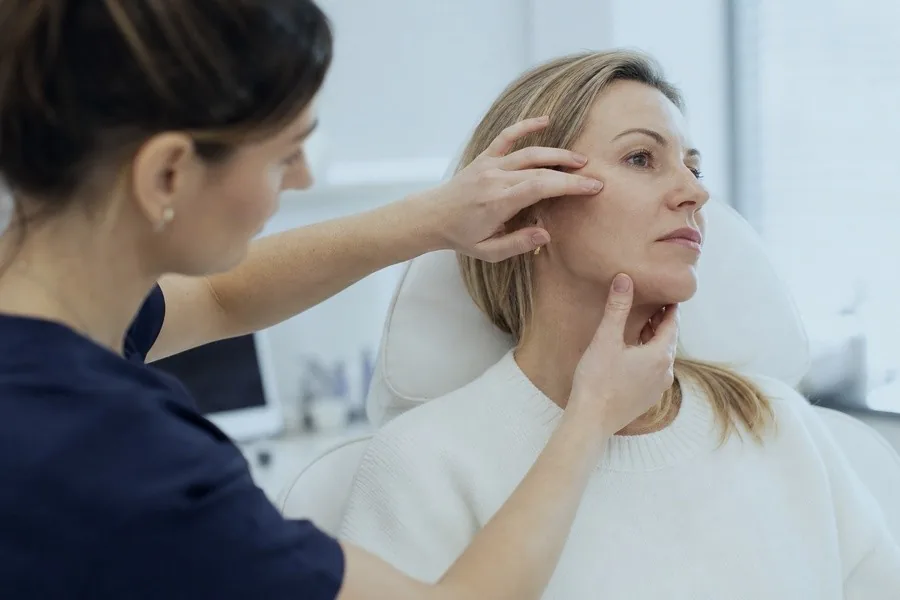
What hemifacial spasm looks like
The first sign is usually a flicker of the lower eyelid on one side. Over months or years the twitching tends to spread: the eye closes, the cheek lifts and the corner of the mouth pulls up and out. Some people hear a clicking sound in the ear on that side. The spasms come in bursts and can be set off by talking, smiling, eating or stress.
A telling feature is that hemifacial spasm continues during sleep, which is unusual for movement problems of the face. Partners sometimes notice it at night before the person is aware of how often it happens.
Hemifacial spasm causes
In most people the cause is a small artery or vein lying against the facial nerve at the point where it leaves the brainstem. The constant pulsing contact is thought to irritate the nerve, so that it fires on its own and sets off the muscles it supplies.
Hemifacial spasm can sometimes follow Bell's palsy or another injury to the facial nerve, as the nerve heals with crossed connections. Rarely, a tumour, cyst or other lesion near the nerve is responsible. That is why an MRI scan of the brain is usually arranged, even though most scans show only the blood vessel or nothing of concern.
Is hemifacial spasm dangerous?
Hemifacial spasm itself does not damage the brain, the nerve or the eye, and it does not lead to a stroke. Once a scan has excluded a rare underlying cause, it is regarded as a benign condition.
That does not make it trivial. When the eye on the affected side keeps closing, reading and driving become difficult, and many people feel self-conscious in conversation or at work. These effects on daily life and confidence are good reasons to seek treatment rather than putting up with it.
Hemifacial spasm vs blepharospasm vs facial tic
Strictly speaking, hemifacial spasm is not a dystonia. It begins in the facial nerve, whereas dystonias such as blepharospasm arise from the brain's movement-control circuits. The two can look alike at first, so the distinction is made by looking closely at the pattern.
Facial tics are different again. They are brief, repeated movements, often starting in childhood, that a person can hold back for a while with effort, usually with a building urge beforehand. Tics vary in where they appear; hemifacial spasm stays on one side and cannot be suppressed.
Hemifacial spasm treatment
The usual approach in the UK is injection treatment into the twitching muscles. It relaxes the over-active muscles for a period of months and is repeated every few months, with the dose adjusted each visit. Most people notice the twitching becoming much less obvious, although some weakness of the treated muscles can occur for a while.
For selected people, particularly younger and fit patients with a clear vessel on the scan, a neurosurgical operation called microvascular decompression can move the vessel away from the nerve. It is carried out at NHS neurosurgical centres, and the risks and benefits are discussed there in detail.
Whether injection treatment is suitable for you is confirmed at a consultant assessment. Bridge House Clinic does not have a neurologist or neurosurgeon on site, so referral elsewhere is discussed if a scan or surgical opinion is needed.
Getting help
Your GP is a sensible first stop, and can arrange or request the scan. You can also book directly for an assessment with Dr Arvin Rodrigues, Consultant Clinical Neurophysiologist, without a referral.
This article is general information and not a diagnosis. See your GP or call NHS 111 if one side of your face becomes weak or droops, or if twitching comes with hearing loss or new headaches. Call 999 for sudden facial weakness, weakness or numbness of an arm or leg, slurred speech or confusion, which can be signs of a stroke.
Common questions
Is hemifacial spasm dangerous? +
It is not dangerous in itself and does not harm the brain or eye. An MRI scan is usually arranged to rule out a rare cause such as a tumour pressing on the nerve.
Is hemifacial spasm a type of dystonia? +
No. It starts in the facial nerve rather than in the brain's movement circuits, although it is often treated in a similar way to focal dystonias.
Will hemifacial spasm go away on its own? +
It rarely settles without treatment and often spreads slowly over time. It is treatable, and most people get good control of the twitching.
Why does my face twitch when I'm asleep? +
Continuing twitches during sleep is a typical feature of hemifacial spasm, because the irritated nerve fires regardless of whether you are awake. Mention it to the doctor assessing you.
Can stress cause hemifacial spasm? +
Stress and tiredness can make the twitching more frequent, but they are not the cause. The underlying problem is usually irritation of the facial nerve.