Why anxiety causes tingling: the over-breathing link
When you feel anxious or panicky, breathing often speeds up or becomes deeper without you noticing. This over-breathing, sometimes called hyperventilation, blows off more carbon dioxide than the body produces. The resulting shift in blood chemistry makes nerves fire more easily, and the first places people feel it are usually the fingertips and around the lips.
Because the change affects the whole body at once, the tingling is usually on both sides. It can come with light-headedness, a racing or thumping heart, chest tightness, a feeling of not getting a full breath, and sometimes cramping of the hands. These are frightening sensations, but they are a recognised and reversible response.
Anxiety can also make you more aware of ordinary body sensations, so mild tingling that would otherwise go unnoticed can feel prominent.
Tingling in face and hands: what it feels like with anxiety
People describe a tingling feeling in face and hands as pins and needles, buzzing, or a cold, fizzing numbness. It often starts around the mouth, nose or cheeks and in the fingers of both hands, and may spread to the feet. It typically builds over a few minutes during an anxious spell and fades as breathing settles, often within half an hour.
It can also happen when you do not feel especially anxious, for example during long periods of stress, after a poor night's sleep, or while lying awake worrying. Many people breathe in a shallow, upper-chest pattern without realising, and that alone can bring on symptoms.
Anxiety or a nerve? Telling the two apart
Tingling from a trapped or damaged nerve behaves differently from anxiety-related tingling, and a few features usually separate them.
None of these rules is absolute, and anxiety and a nerve problem can exist side by side. If the pattern is unclear, a doctor can help sort it out.
Migraine aura and other causes of a tingling sensation in face and hands
Migraine aura is another common cause. The tingling usually starts in the fingers of one hand and spreads slowly up the arm to the face, often the lips and tongue, over several minutes, and can last up to an hour. It may come with visual changes such as zigzag lines, and a headache often, though not always, follows.
Because migraine aura is usually one-sided, it can look like a stroke. Slow spreading over minutes is typical of migraine, whereas stroke symptoms tend to appear suddenly. If it is the first time, or you are in any doubt, treat it as an emergency. Low blood calcium and some prescription medicines can also cause tingling around the mouth and fingers, which your GP can check.
When a nerve test is useful, and when it is not
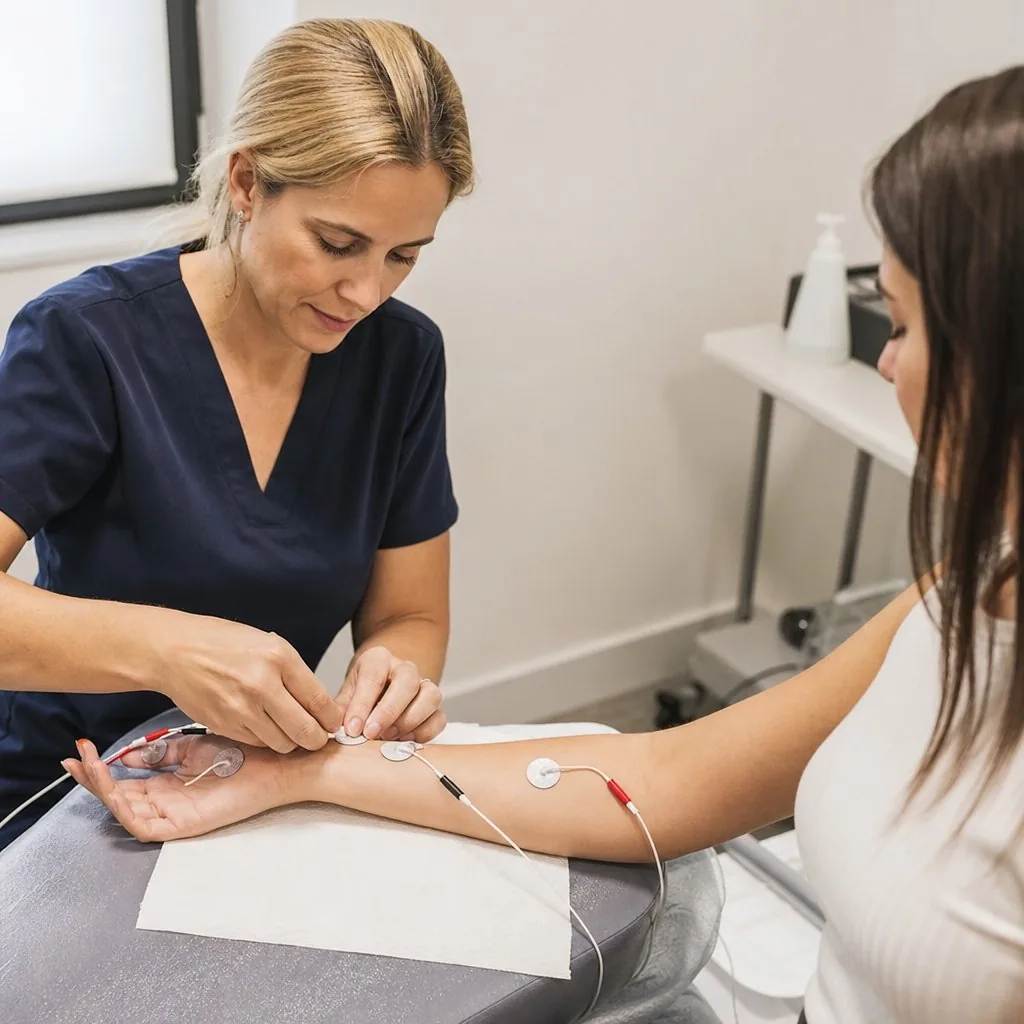
A nerve conduction study measures the nerves in the arms and legs. It is useful when tingling is persistent, follows a finger pattern, affects one hand, or comes with weakness or numbness that does not go away between anxious spells. It can confirm or rule out carpal tunnel syndrome, an ulnar nerve problem at the elbow, or a neuropathy.
A routine study does not look at the face, and it cannot diagnose anxiety or migraine. For tingling that is clearly linked to panic and settles fully afterwards, it is unlikely to add much. Where there is doubt, though, a normal result is genuinely reassuring: it shows the limb nerves are conducting normally, and many people find that helps them worry less about the sensations. Dr Arvin Rodrigues performs and explains the test in one visit.
When face tingling needs urgent care
Use the 'FAST' check: Face drooping on one side, Arm weakness, Speech slurred or muddled, Time to call 999. Sudden tingling or numbness on one side of the face with any of these, or with sudden confusion, loss of vision or a severe headache, may be a stroke and needs an ambulance straight away.
This article is general information and not a diagnosis. If tingling is new, frequent or worrying you, see your GP or call NHS 111. If anxiety or panic attacks are affecting your daily life, talk to your GP; depending on where you live, you may also be able to refer yourself to NHS talking therapies.
Common questions
Is tingling in one hand likely to be anxiety? +
Less likely. Tingling in hand and face from anxiety is usually on both sides. Tingling in one hand, especially in a finger pattern, is more often a nerve problem and is worth having checked.
How long does anxiety tingling last? +
Usually minutes, easing as breathing returns to normal. Tingling that persists for days or between anxious episodes suggests another cause.
Can a nerve conduction study show anxiety? +
No. It measures how the nerves in the limbs conduct. A normal result can be reassuring if you are worried about nerve damage, but it does not diagnose anxiety.
Should I go to A&E for tingling in my face? +
Call 999 if face tingling comes on suddenly on one side with weakness, drooping, slurred speech or confusion. For tingling that comes and goes with anxiety and settles on its own, your GP is the right place to start.
What does a nerve test cost? +
Consultation + nerve conduction study & EMG — upper limbs £450, lower limbs £500, upper and lower limbs £550. You can book without a GP referral.