What happens at the examination
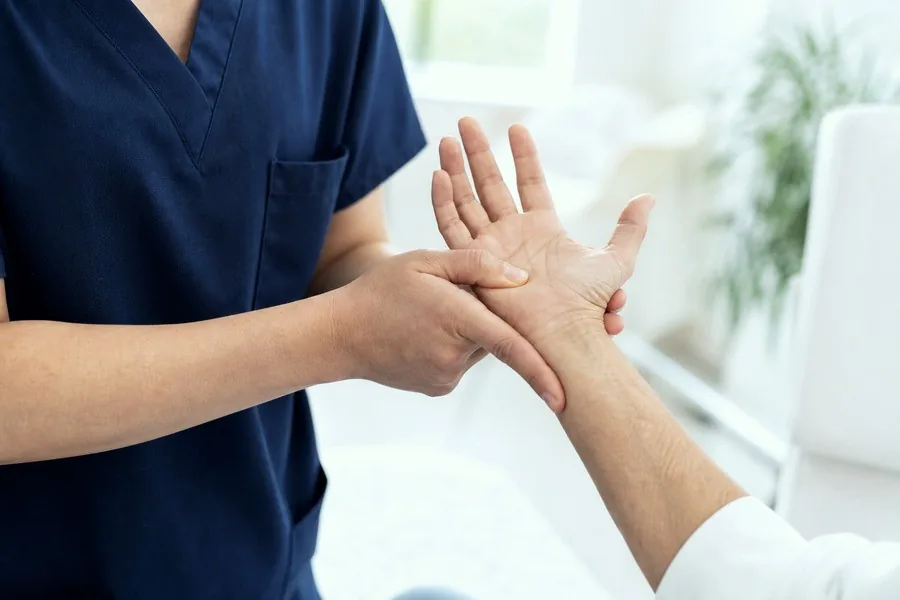
Diagnosis starts with your story: which fingers are affected, what brings the symptoms on, whether they wake you, and whether your grip or dexterity has changed. The examination then looks for signs that the ulnar nerve is irritated at the elbow rather than somewhere else along its course.
None of these checks is uncomfortable for more than a moment, and they take only a few minutes. They point towards the diagnosis, but on their own they cannot measure how much the nerve is affected.
The cubital tunnel syndrome test: nerve conduction across the elbow
The key investigation is a nerve conduction study of the ulnar nerve. Small sensors are placed over a hand muscle and the little finger, and the nerve is stimulated with brief pulses at the wrist, just below the elbow and just above it. Comparing the speed and size of the signal between these points shows whether there is a slowdown across the elbow segment specifically.
Because the elbow position changes the measured length of the nerve, the study is done with the elbow bent at a consistent angle. The median nerve is usually tested too, both to compare and to see whether carpal tunnel is also present, which happens more often than people expect.
What EMG of the hand muscles adds
If the nerve study shows a problem, EMG is often added. A fine recording needle is placed in one or two muscles the ulnar nerve controls, typically the muscle between the thumb and index finger and one at the edge of the palm. It shows whether the nerve fibres themselves have been damaged rather than just slowed, and whether there are signs of ongoing loss or of recovery.
EMG can also help rule out a nerve root problem in the neck, which can mimic cubital tunnel, by checking muscles supplied by the same root but a different nerve.
Mild, moderate or severe: grading the results
The results are usually summarised as a grade. Mild changes mean the nerve is slowed across the elbow but still carries a good signal. Moderate changes show more marked slowing, sometimes with a smaller response. Severe changes include a much reduced or absent signal, or EMG evidence that muscle fibres have lost their nerve supply.
Grading matters because it guides what happens next. Mild cases are commonly managed conservatively, while severe cases are more likely to be referred for a surgical opinion. Dr Arvin Rodrigues performs and interprets the study himself and explains the grade to you before you leave, with a written report to follow.
Difference between carpal tunnel and cubital tunnel
The two conditions are often confused because both cause tingling and numbness in the hand. They involve different nerves at different joints, and a few questions usually separate them.
Weakness and clawing: when it's advanced
When the ulnar nerve has been under pressure for a long time, the hand can change shape. The muscles between the finger bones thin, leaving grooves on the back of the hand, and the hollow next to the thumb deepens. The little and ring fingers may curl at the middle joints and resist straightening, which is called ulnar claw hand.
This picture of ulnar nerve palsy suggests significant nerve damage and should be assessed promptly. Recovery after pressure is relieved can be slow and incomplete at this stage, which is why earlier testing is worthwhile.
Why testing comes before surgery, and what comes next
Surgeons generally want objective evidence before operating, because the examination alone cannot always separate the elbow from the wrist or the neck, and because a baseline study helps judge recovery afterwards. Treatment then depends on the grade.
This article is general information and not a diagnosis. If your symptoms are getting worse, see your GP or call NHS 111. Call 999 for sudden weakness or numbness of the face, arm or leg, slurred speech or confusion, as these can be signs of a stroke.
Common questions
What is an ulnar nerve test? +
It usually means a nerve conduction study of the ulnar nerve, sometimes with EMG. It measures how well the nerve carries signals along the arm and across the elbow, and whether the hand muscles are affected.
Is there an ulnar nerve test for the hand I can do myself? +
Holding the elbow fully bent for a minute and noticing tingling in the little finger is a simple clue, and so is difficulty pinching paper. These are pointers only; they cannot confirm the site or severity.
Can you have carpal tunnel and cubital tunnel at the same time? +
Yes, the two can coexist, which is one reason both the median and ulnar nerves are usually tested in the same session.
Do I need a GP referral for the test? +
No. You can book directly. Consultation + nerve conduction study & EMG — upper limbs £450, lower limbs £500, upper and lower limbs £550.
Does the cubital tunnel test hurt? +
Most people find the pulses uncomfortable rather than painful, like a quick flick. The EMG needle causes a brief scratch and ache. You can pause at any time.