How is peripheral neuropathy diagnosed?
There is no single scan or blood test that makes the diagnosis on its own. Instead, doctors build a picture in stages: what you are feeling, what they find on examination, what the blood shows, and what the nerves themselves measure. Each step answers a different question — is this neuropathy, what type is it, and why has it happened?
For most people the pathway looks like this.
What your GP checks first
Your GP will ask when the symptoms began, where they started and how fast they have changed. Questions about diabetes, alcohol, diet, recent illnesses, cancer treatment and whether relatives have similar feet or walking problems are all part of the detective work.
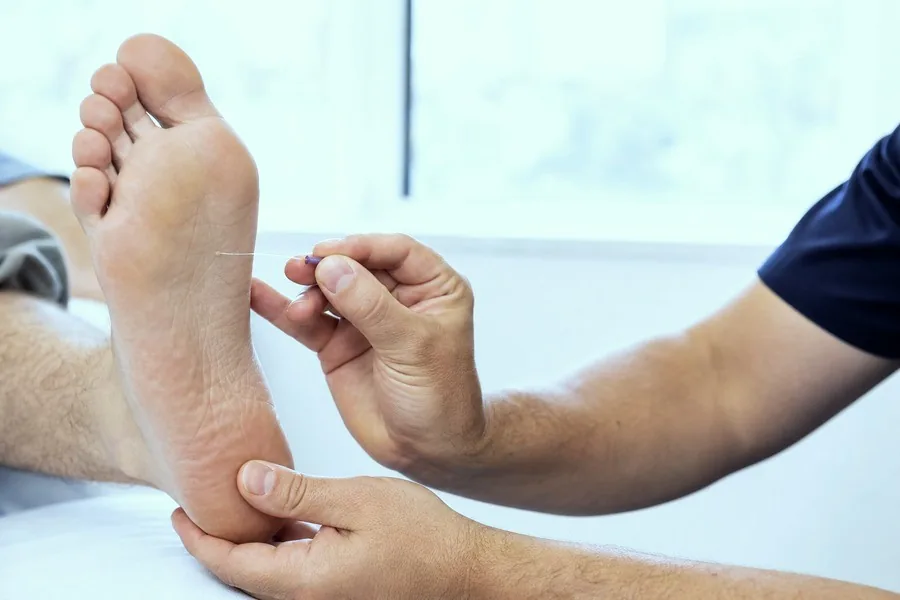
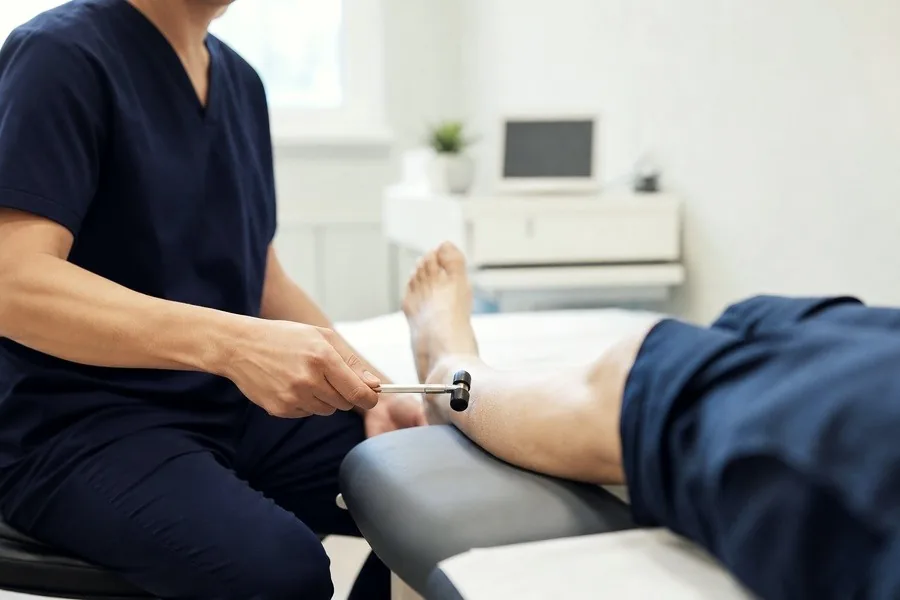
On examination, they may test ankle and knee reflexes, which are often reduced in neuropathy. They may check vibration sense with a tuning fork on the big toe, feeling with a pin or a fine filament, position sense by moving the toe up and down while your eyes are closed, and the strength of the muscles that lift and point the foot. They will also look at the skin of the feet.
Which blood tests are done for peripheral neuropathy?
Peripheral neuropathy bloods are chosen to pick up the common and treatable causes first. Your GP can arrange most of them, and results usually come back within days. If a cause turns up, it can often be dealt with directly.
Depending on your history, extra tests may be added, for example for coeliac disease, certain infections or inflammatory markers.
Can a nerve conduction test diagnose peripheral neuropathy?
Yes — it is the main test that confirms it. Small sensors on the skin record how quickly and strongly signals travel along several nerves in the legs and, where needed, the arms. Because neuropathy usually affects many nerves in a symmetrical, length-dependent way, the overall pattern is distinctive and helps separate it from a trapped nerve in the back or a single compressed nerve.
The study also shows whether the nerve fibres themselves or their insulating coating are mainly affected, and how severe the changes are. One limitation is worth knowing: it measures the larger nerve fibres. If only the tiny fibres that carry pain and temperature are involved — small-fibre neuropathy — the study can be normal, and a skin biopsy may be considered. Scans are rarely needed unless a spinal cause is suspected.
Seeing a peripheral neuropathy specialist in the UK
Two types of consultant are usually involved. A consultant clinical neurophysiologist specialises in measuring nerve and muscle function and performs and interprets nerve conduction studies and EMG. A neurologist looks after the wider management of nerve conditions, particularly inflammatory, rapidly progressing or inherited types.
At Bridge House Clinic, Dr Arvin Rodrigues is a Consultant Clinical Neurophysiologist with a special interest in nerve conduction studies and EMG. He takes a history, examines you, carries out the study and explains the findings in the same visit, followed by a written report. If the results suggest you need a neurologist, the report gives your GP what they need to refer you on.
Cost, waiting times and when to seek urgent help
On the NHS, nerve conduction studies are arranged by hospital referral, and waits vary by area and can be long. Privately, you can book directly with no NHS waiting list, and you can often be seen this week.
This article is general information and not a diagnosis. For new or worsening symptoms, see your GP or call NHS 111. Call 999 for weakness spreading over hours or days, difficulty breathing or swallowing, or sudden weakness or numbness of the face, arm or leg with slurred speech or confusion, which can mean a stroke.
Common questions
How much is a neuropathy test? +
At Bridge House Clinic: Consultation + nerve conduction study & EMG — upper limbs £450, lower limbs £500, upper and lower limbs £550. The consultation and test happen in one visit.
Can alcoholic peripheral neuropathy be reversed? +
Sometimes partly. If drinking stops and nutrition improves, nerves may recover to some degree over months to years. How much depends on how long and how severe the damage has been, so no outcome can be promised.
Do I need a GP referral for a nerve conduction study? +
Not privately. You can book directly. A GP letter or recent blood results are helpful but not essential.
Can a nerve conduction study be normal if I have neuropathy? +
Yes, in small-fibre neuropathy, which affects only the tiniest nerve fibres. Your symptoms and examination are still taken seriously, and other tests may be considered.
Will I need an MRI scan? +
Usually not for neuropathy. A scan may be considered if the pattern suggests a problem in the spine rather than the nerves themselves.