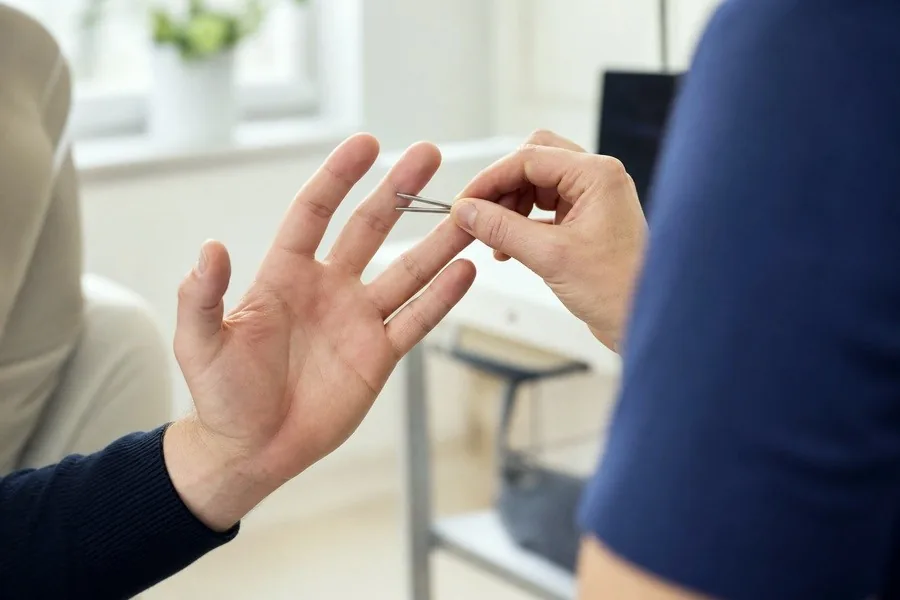
Symptoms of nerve damage in a finger after a cut
Each finger has two small digital nerves, one on each side, running close to the skin. A cut from glass, a knife or a tool can divide one of them even when the wound itself looks small. The tell-tale sign is numbness on one side of the finger beyond the cut, towards the fingertip.
Some people also notice that the fingertip feels dry, because sweating is reduced in the numb area, or that they cannot feel the difference between sharp and blunt. Pain at the wound is not a reliable guide: a cleanly divided nerve may hurt very little.
Fresh cuts with numbness: be seen on the day of injury
If you have numbness after a cut, do not wait to see whether it settles. Go to A&E or a minor injuries unit (urgent treatment centre in England) on the day of the injury. A divided nerve or tendon is usually repaired by a hand surgeon, and the timing matters; the surgeon decides whether and when to operate.
A nerve conduction study has no role in those first days, because a cut nerve can still conduct below the injury for a short time. The decision is made on examination, and sometimes by looking at the nerve directly during wound exploration.
Median, ulnar and radial nerve injury in the hand and wrist
Three main nerves cross the wrist. The median nerve supplies feeling to the thumb, index, middle and half of the ring finger, and the muscles that bring the thumb across the palm. An injury of the median nerve at the wrist, often from a glass injury, can leave the thumb side of the hand numb and the pinch weak.
Ulnar nerve injury affects the little finger and half of the ring finger, and many of the small muscles that control fine finger movement and grip. The radial nerve gives feeling over the back of the hand near the thumb; at the wrist its branch is purely sensory, so an injury there causes numbness or painful tingling rather than weakness.
Bruised, stretched or cut: three grades of nerve injury
A bruised or compressed nerve stops conducting for a while but its fibres stay intact. This is called neurapraxia, and it usually recovers over days to weeks. A more severe crush or stretch breaks the fibres inside an intact outer sheath (axonotmesis); the fibres then regrow from the injury point.
When the nerve is fully divided (neurotmesis), the ends need to be brought together surgically for useful regrowth to happen. Telling these grades apart is one of the main reasons for testing once the early period has passed.
When a nerve conduction study helps after a hand injury
From about two to three weeks, a nerve conduction study with EMG can show whether fibres have been lost and roughly how many. Repeating the test over months shows whether the nerve is regrowing, sometimes before you can feel the change yourself.
Testing is also used before or after hand surgery to give a baseline and to judge progress, and to document the findings neutrally for work or insurance purposes. Questions about nerve or tendon repair are for a hand surgeon; at Bridge House Clinic that is Miss Kasia Studnicka-Perkin, Consultant Hand & Wrist Surgeon.
What recovery feels like, and when to get help
A regrowing nerve often announces itself with tingling. Tapping over the nerve may cause shocks felt in the fingers, and the point where this happens tends to move further along as the nerve grows, which doctors call an advancing Tinel's sign. The returning skin can be very sensitive for a time. Regrowth is often described as roughly a millimetre a day, so recovery in the fingers can take many months and is not always complete.
This article is general information and not a diagnosis. For a new cut with numbness, weakness or a finger that will not bend, go to A&E or a minor injuries unit (urgent treatment centre in England); otherwise see your GP or call NHS 111. Call 999 for heavy bleeding that will not stop with firm pressure, or for sudden weakness or numbness of the face, arm or leg with slurred speech or confusion.
Common questions
What does nerve damage in the hand feel like? +
Usually numbness or reduced feeling in part of the hand, sometimes with tingling, burning or electric shocks around a scar. With larger nerves there may be weakness of grip or pinch.
How soon after a cut can a nerve be tested? +
A nerve conduction study is usually most informative from about two to three weeks after the injury. In the first days, examination by the treating team decides whether surgery is needed.
Can nerve damage in a finger heal by itself? +
A bruised or stretched digital nerve often recovers on its own over weeks to months. A fully cut nerve usually needs surgical repair for useful recovery, which is why fresh cuts with numbness need urgent assessment.
Is a nerve conduction study useful after nerve repair surgery? +
Yes. Repeat studies can show whether the nerve is regrowing and help your surgeon judge progress. Consultation + nerve conduction study & EMG — upper limbs £450, lower limbs £500, upper and lower limbs £550.